





Green Chemistry Education in the News:
Select a Category
From Principles to Practice: Reflections from the 2026 GCC Summit
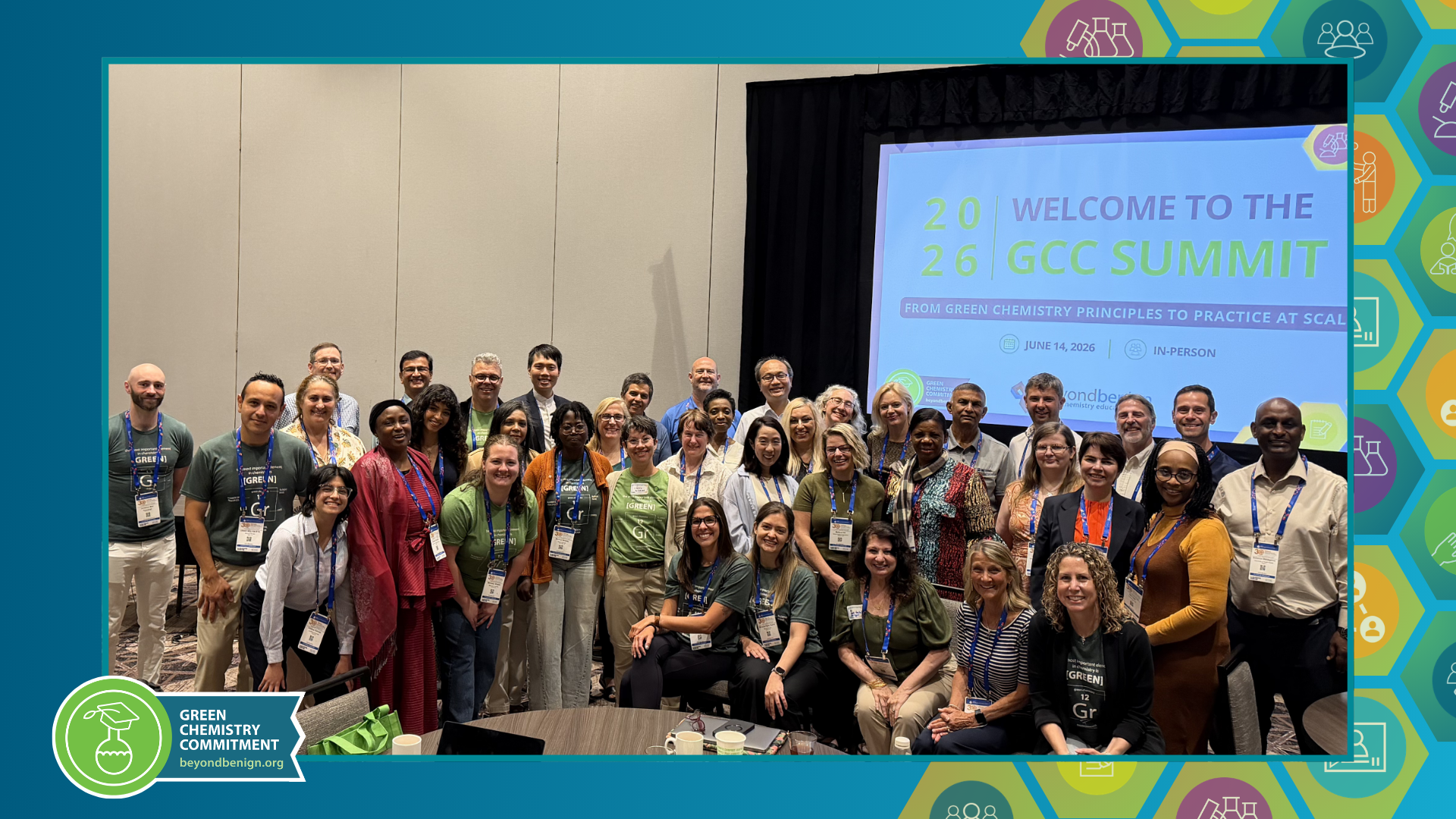
Each year, Beyond Benign’s Green Chemistry Commitment (GCC) Summit brings together educators, researchers, industry leaders, and changemakers from around the world to advance a shared vision for chemistry education. In 2026, the GCC community came together through both a virtual gathering and an in-person event held alongside the 30th Green Chemistry & Engineering Conference (GC&E), welcoming a total of 135 participants from 22 countries. United by the theme From Green Chemistry Principles to Practice at Scale, attendees explored how to move green chemistry beyond guiding principles and into everyday practice.
Across keynote presentations, panel discussions, talks from our GCC signers, and collaborative working groups, participants examined how research can shape curriculum, how education can better prepare students for the workforce, and how global collaboration can accelerate meaningful change across institutions and communities.
Together, the virtual and in-person gatherings reflected a community focused not only on imagining a more sustainable future for chemistry but on building the tools, partnerships, and momentum needed to make that future a reality.
GCC Summit Highlights: Key Conversations & Catalysts
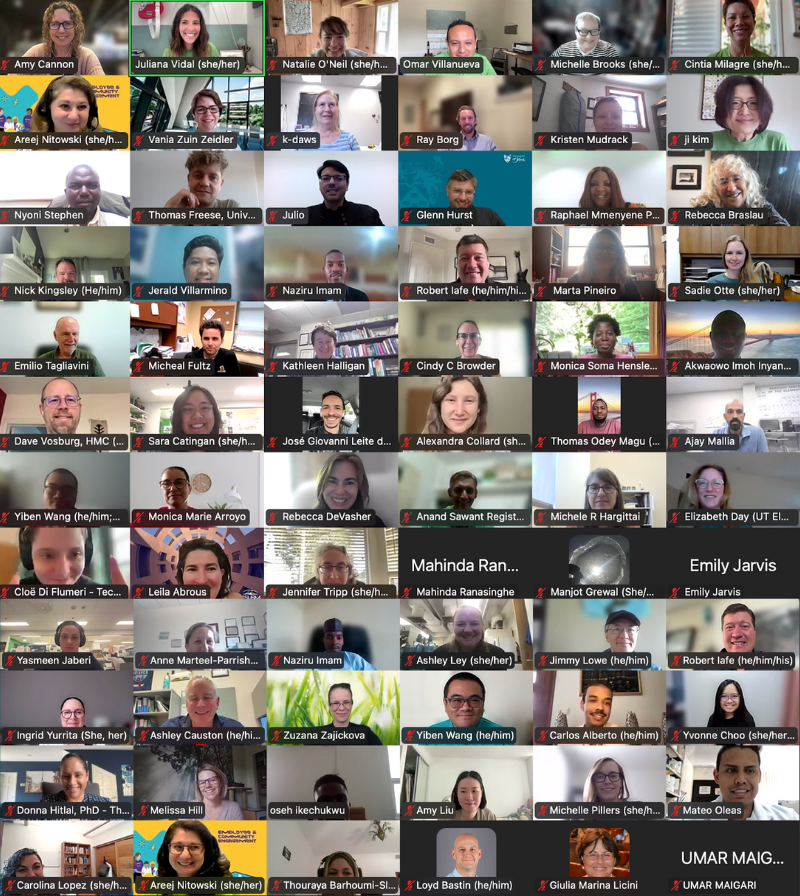
Across both the virtual Summit and the in-person gathering at the 2026 GC&E, several themes emerged, reflecting the GCC community’s shared vision for advancing green chemistry education.
1. From Principles to Practice at Scale
The 2026 GCC Summit centered on a challenge that is becoming increasingly urgent across higher education, research, and industry: How do we move green chemistry beyond a set of guiding principles and into everyday practice?
Throughout both Summit gatherings, speakers returned to the idea that green chemistry education is no longer just about introducing students to the 12 Principles. It’s about preparing them to apply those principles to real-world challenges, from designing safer chemical processes to developing new materials, transforming laboratory practices, and advancing sustainability across industries.
The Summit’s keynote presentations—delivered by Dr. Audrey Moores (McGill University) during the virtual Summit and by Dr. Glenn Hurst (University of York) during the in-person gathering—both explored how advances in green chemistry research can catalyze curriculum transformation. While each speaker brought a unique perspective, both emphasized the importance of connecting cutting-edge research with classroom learning to prepare students for the real-world application of green chemistry.
That emphasis on real-world application was perhaps best captured by Dr. Omar Villanueva, Chief Program Officer at Beyond Benign, who challenged attendees to consider, “Are students actually ready to do green chemistry—or have we simply taught them to name it?” That question became a touchstone throughout the Summit, reinforcing that the future of green chemistry education depends on connecting classroom learning with real-world applications.
2. Bridging Research, Education, and Industry
Throughout the Summit, speakers emphasized that green chemistry advances most effectively when research, education, and industry evolve together, not independently.
Speakers highlighted the importance of breaking down traditional boundaries between the laboratory, the classroom, and the workplace. Rather than viewing education as preparation for future research or industry careers, presenters explored how each of these spaces can actively inform one another. Emerging research can inspire new approaches to teaching, industry can help identify the skills students need to succeed, and educators can prepare graduates to accelerate innovation from day one.
This perspective was reflected throughout both Summit panel discussions, where representatives from academia, industry, and nonprofit organizations—including Boeing, Change Chemistry, Novartis, Green ChemisTree Foundation, and universities across the world—explored how institutions can better align classroom experiences with real-world challenges. Discussions focused on developing graduates who are equipped not only with technical knowledge, but with systems thinking, collaboration, and problem-solving skills needed to drive sustainable innovation.
The theme also emerged in the talks from our GCC signers, where educators shared examples of translating research into curriculum, expanding professional development opportunities, and creating resources to make green chemistry more accessible to faculty and students worldwide. Together, these examples demonstrated that meaningful change doesn’t happen at a single point in the educational pipeline—it happens through ongoing collaboration among researchers, educators, students, and industry leaders.
Students are really craving this change … it’s really on us to support that innovation and, in some cases, just get out of the way.”
Most of our students will go into environments that don’t speak our language. They don’t speak chemistry, they don’t speak chemical engineering, and they need to be able to translate what that means.”
3. Growing a Global Community of Change
The 2026 GCC Summit also highlighted the growing international reach of the GCC program and the power of a global community working toward a shared vision for chemistry education.
Throughout the event, speakers shared examples of green chemistry taking root in diverse educational and cultural contexts. From Canada to France, Brazil, Zimbabwe, India, Ireland, and beyond, presenters demonstrated that while every institution faces unique opportunities and challenges, the underlying goal remains the same: equipping students to build a more sustainable future through chemistry.
The presentations from our GCC signers offered compelling examples of how this work is expanding around the world. Speakers highlighted the development of regional Communities of Practice, institutional transformation efforts,, and new academic pathways for green chemistry education, alongside professional development opportunities and teaching resources that support educators.
One particularly inspiring example came from Zimbabwe, where educators are building new pathways for green chemistry education through curriculum development, faculty collaboration, and the creation of new academic programs. Their work reflected a broader theme that emerged throughout the Summit: As the GCC community grows, so does its capacity to inspire local leadership and create lasting impact within institutions, regions, and countries.
“A structured community of practice is essential for knowledge exchange, policy influence, curricular development…”
4. Giving Educators Practical Pathways to Action
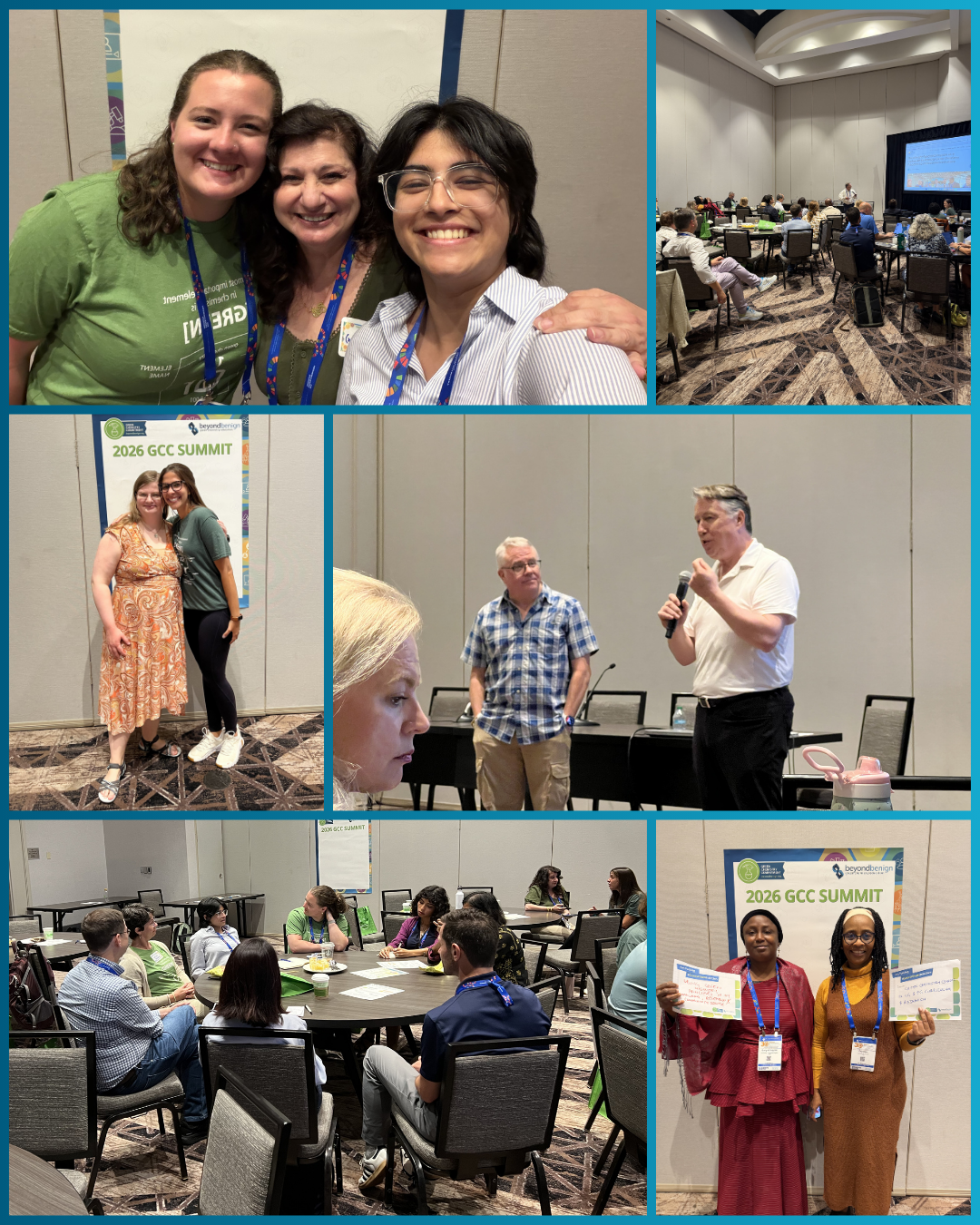
While the Summit explored ambitious ideas for the future of chemistry education, educators remained firmly grounded in practical implementation. Across presentations, panel discussions, and collaborative sessions, speakers shared tangible strategies, teaching tools, and resources that educators can begin applying in their own classrooms and institutions.
Across both Summit gatherings, presenters showcased a wide range of approaches for embedding green chemistry into existing curricula—from redesigning laboratory experiments and introducing emerging research topics to developing professional development opportunities and creating accessible teaching resources. Rather than suggesting that meaningful change requires a complete curriculum overhaul, many speakers emphasized that transformation often begins with thoughtful, incremental steps that build momentum over time.
Sessions also highlighted resources designed to make those steps more accessible. During the virtual Summit, Dr. Deborah Bromfield Lee (Florida Southern College) shared Beyond Benign’s An Introduction to Undergraduate Green Chemistry Teaching and Practice course, which supports educators in bringing green chemistry into undergraduate teaching and curriculum design. At the in-person Summit, Dr. Tom Umile (Villanova University) introduced an easy-to-use template for creating green chemistry case studies, developed with support from Beyond Benign and ACS GCI, to help instructors create classroom materials based on real-world chemistry examples.
This focus on action continued throughout the Summit’s collaborative working groups, where participants exchanged ideas, discussed common challenges, and explored solutions related to curriculum development, resource sharing, institutional change, and student engagement. These conversations provided attendees with opportunities to learn from peers facing similar challenges while building new professional connections across the GCC community.
The Summit also introduced a new GCC signer benefit developed through Beyond Benign’s partnership with Vernier Science Education: a discounted Green Chemistry Starter Package featuring sensors, accessories, and ready-to-teach laboratory experiments designed to support safer, lower-waste chemistry instruction. Together with the many resources highlighted throughout the Summit, this new offering reflects Beyond Benign’s ongoing commitment to providing partnerships and equipping educators with practical tools that make implementing green chemistry more accessible.
The students are hungry for this stuff.”
5. Students as the Next Generation of Green Chemistry Leaders
Underlying each of these conversations was a shared commitment to preparing the next generation of green chemistry leaders.
Speakers repeatedly emphasized that preparing students for this role requires more than teaching foundational concepts. It means creating learning experiences that encourage curiosity, critical thinking, collaboration, and systems thinking while empowering students to address complex sustainability challenges with confidence.
Several presenters shared examples of students engaging directly with real-world research, contributing to curriculum innovation, and helping advance greener laboratory practices. Others highlighted how exposing students to industry perspectives, interdisciplinary collaboration, and emerging research areas can help them better understand the broader impact of chemistry beyond the classroom.
The Summit’s closing presentations placed this focus on the next generation within the larger challenge of moving green chemistry from principles to widespread practice. During the virtual gathering, Dr. John Warner, Beyond Benign co-founder and Chief Executive Officer and Chief Technology Officer of Technology Greenhouse, explored the connections between research innovation and industrial implementation. At the in-person gathering, Warner joined Dr. Paul Anastas, Professor at Yale University, to reflect on what it will take to accelerate the broader adoption of green chemistry. Their closing perspectives reinforced the importance of preparing the scientists entering classrooms, laboratories, and workplaces today to help shape how chemistry is practiced tomorrow.
This commitment to student leadership was also reflected in the Summit’s collaborative working groups, which were facilitated by educators, graduate students, and emerging leaders from across the GCC community. Together, participants explored how educators can create opportunities for students to take active roles in advancing green chemistry within their institutions and communities, recognizing that lasting transformation depends on equipping learners not only with knowledge, but with the confidence to apply it.
As the GCC community continues to grow, investing in students remains central to its mission. By preparing graduates to think critically, collaborate across disciplines, and lead with sustainability in mind, GCC signers are helping cultivate a generation of scientists ready to move green chemistry from aspiration to action.
#GreenChemInAction: A Global Movement
Launched alongside the 2026 GCC Summit, the #GreenChemInAction campaign invited members of the broader green chemistry community to share how they’re advancing change in classrooms, laboratories, institutions, companies, and communities around the world. Educators, researchers, students, and practitioners shared their work, offering a glimpse into the many ways green chemistry is being put into practice.
Together, these posts offer a snapshot of the creativity, collaboration, and commitment driving the global green chemistry movement.
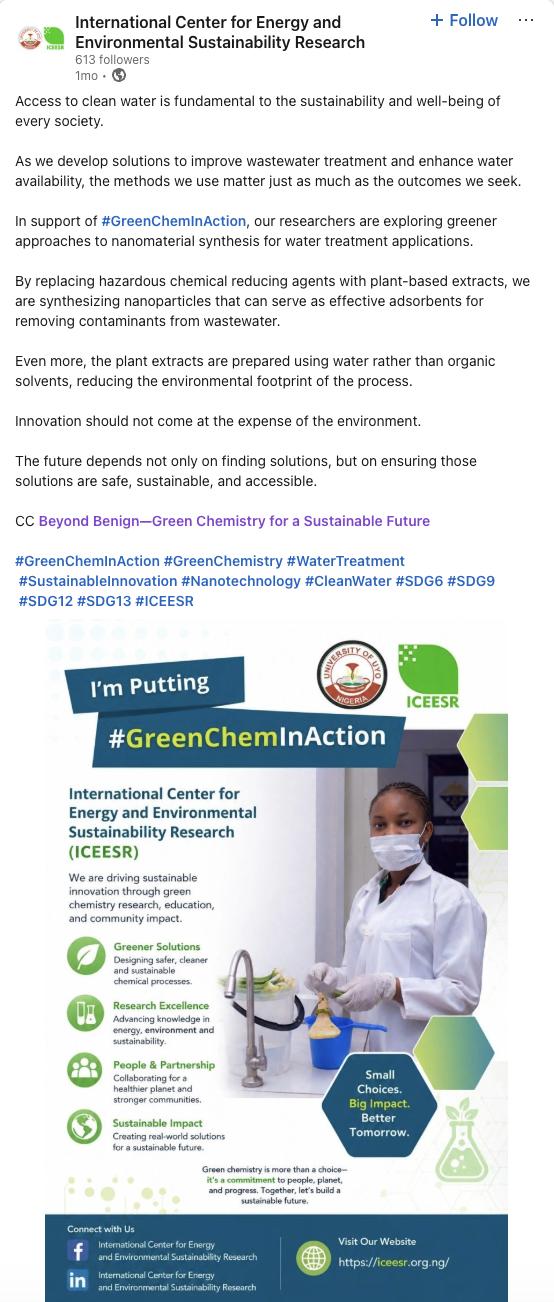
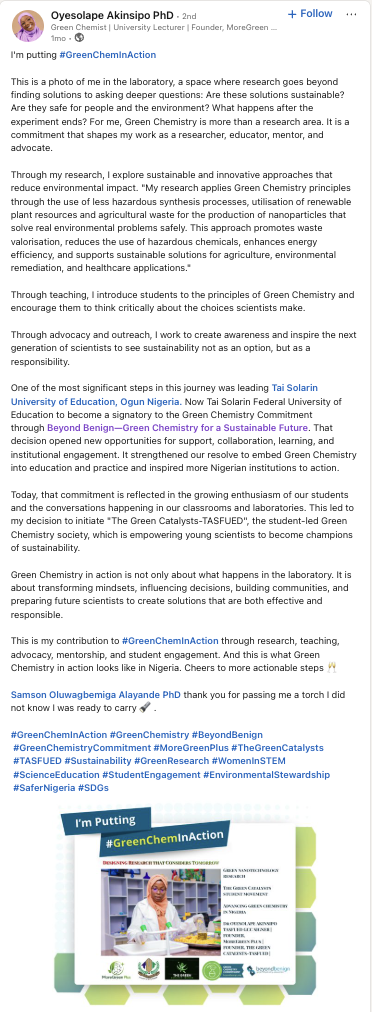
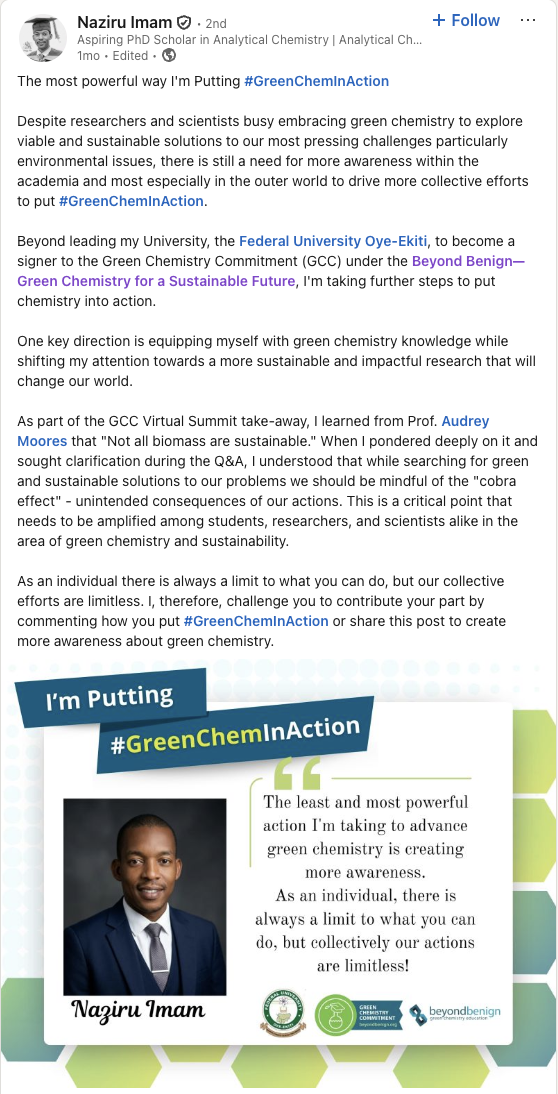
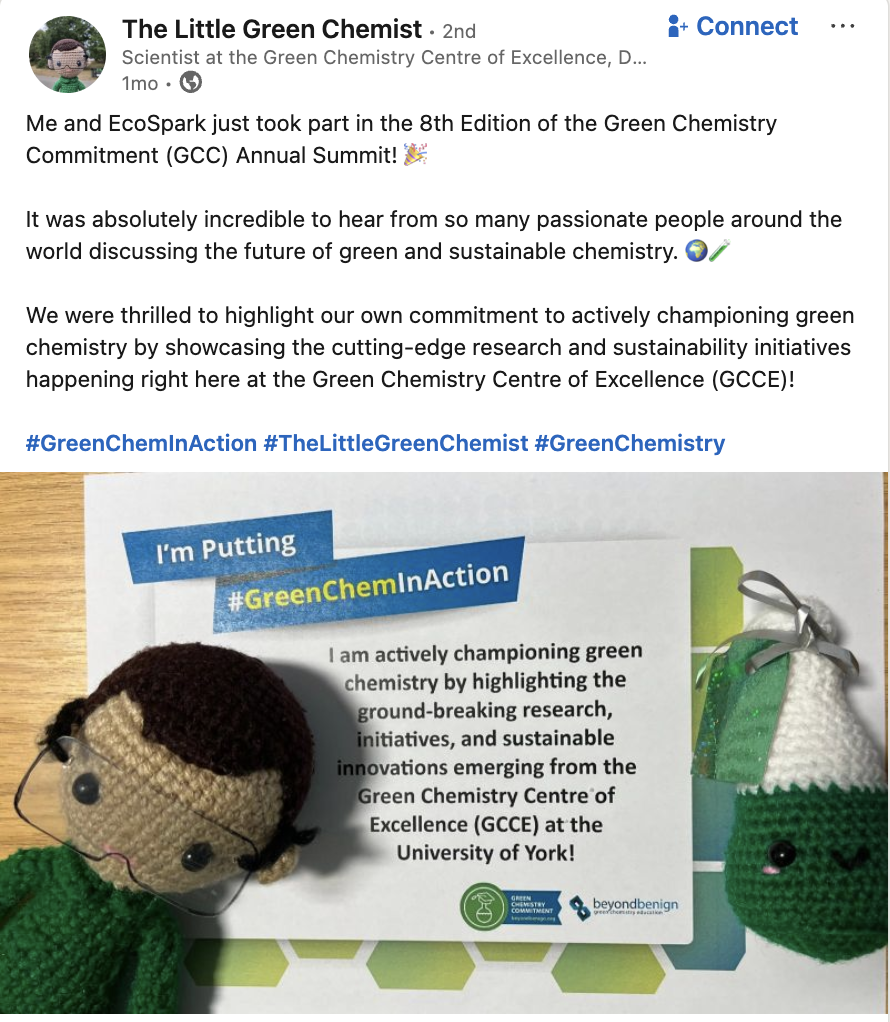
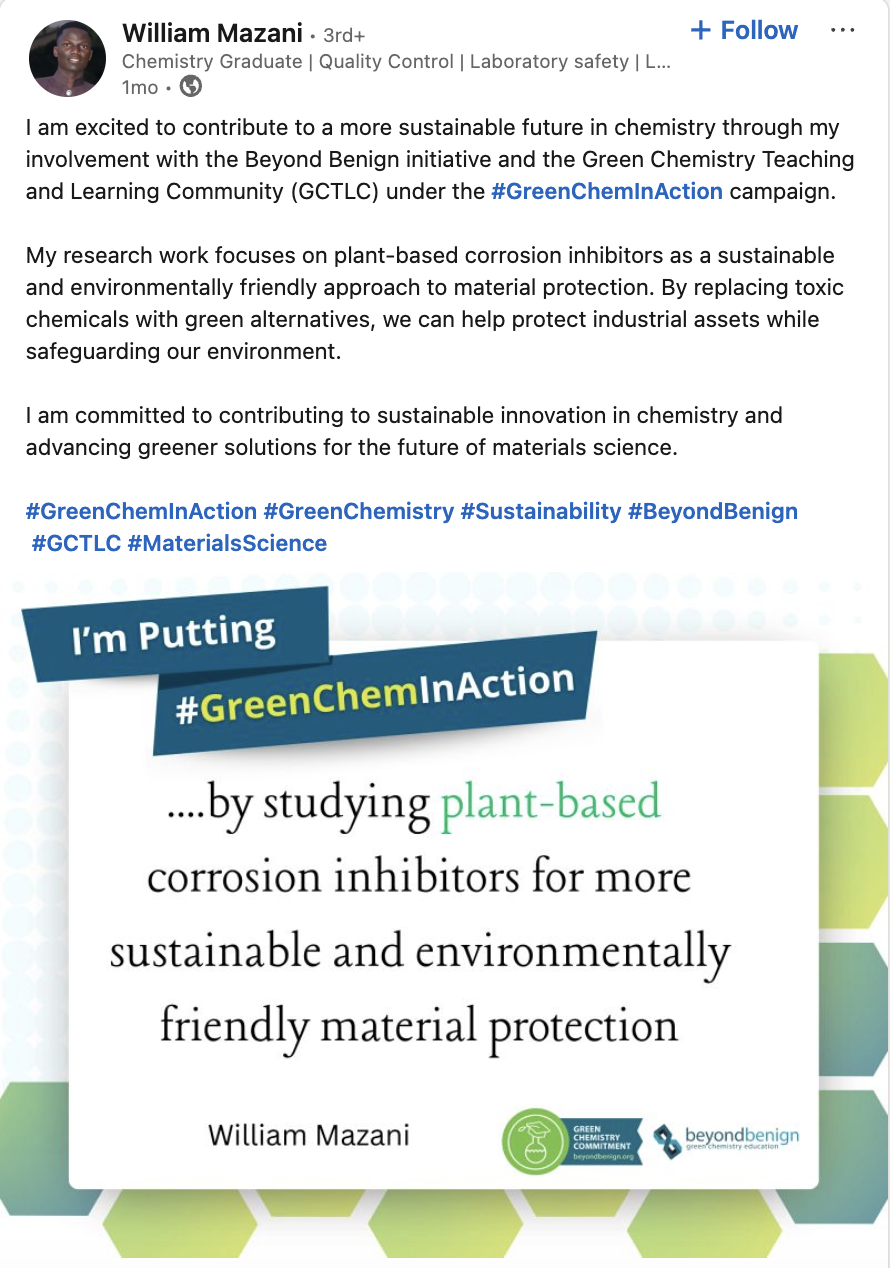
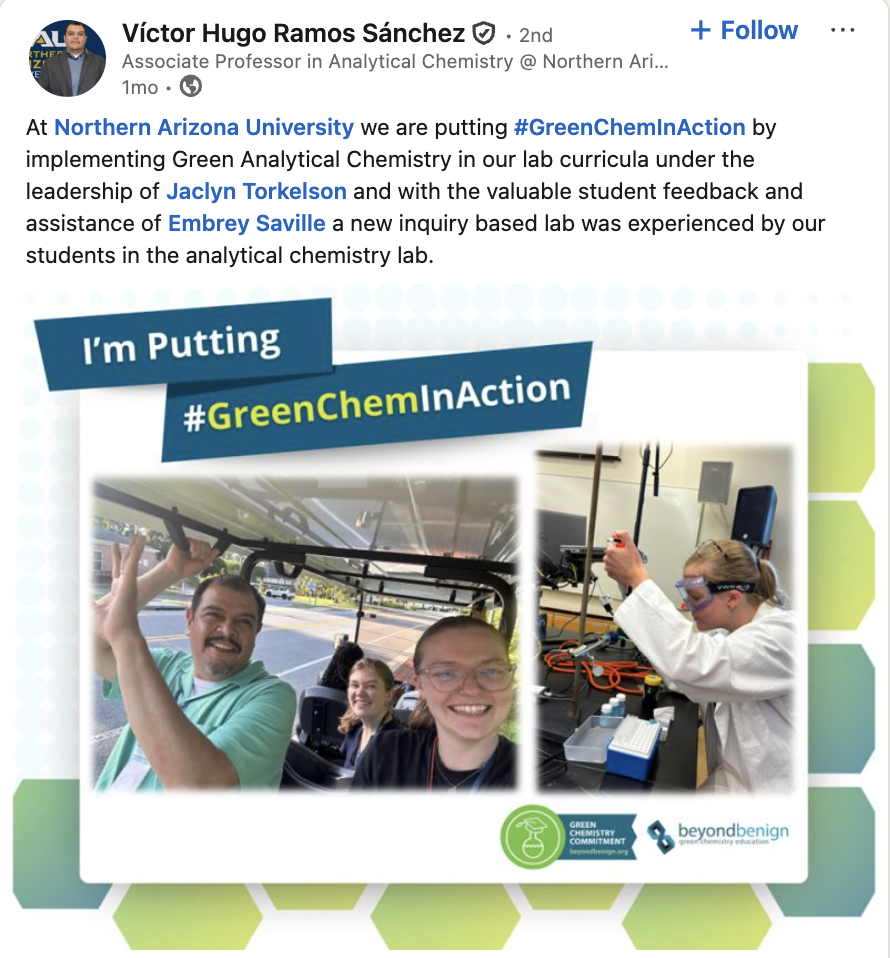
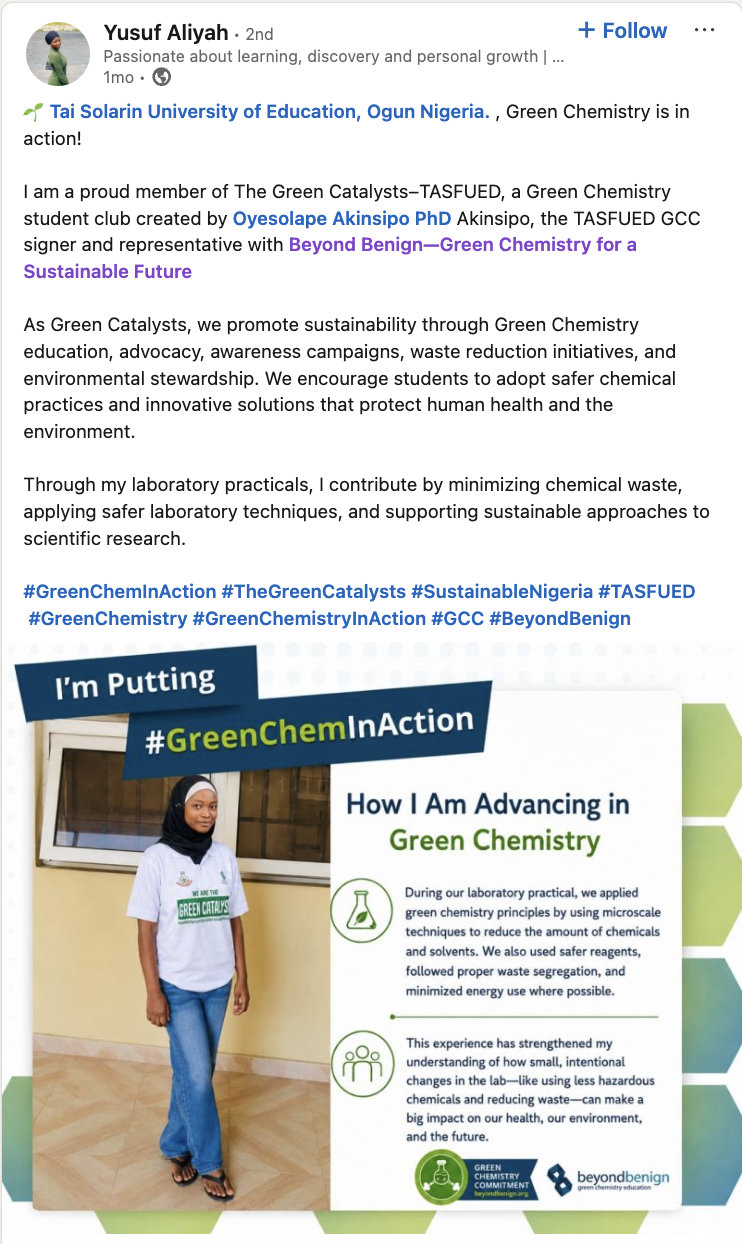
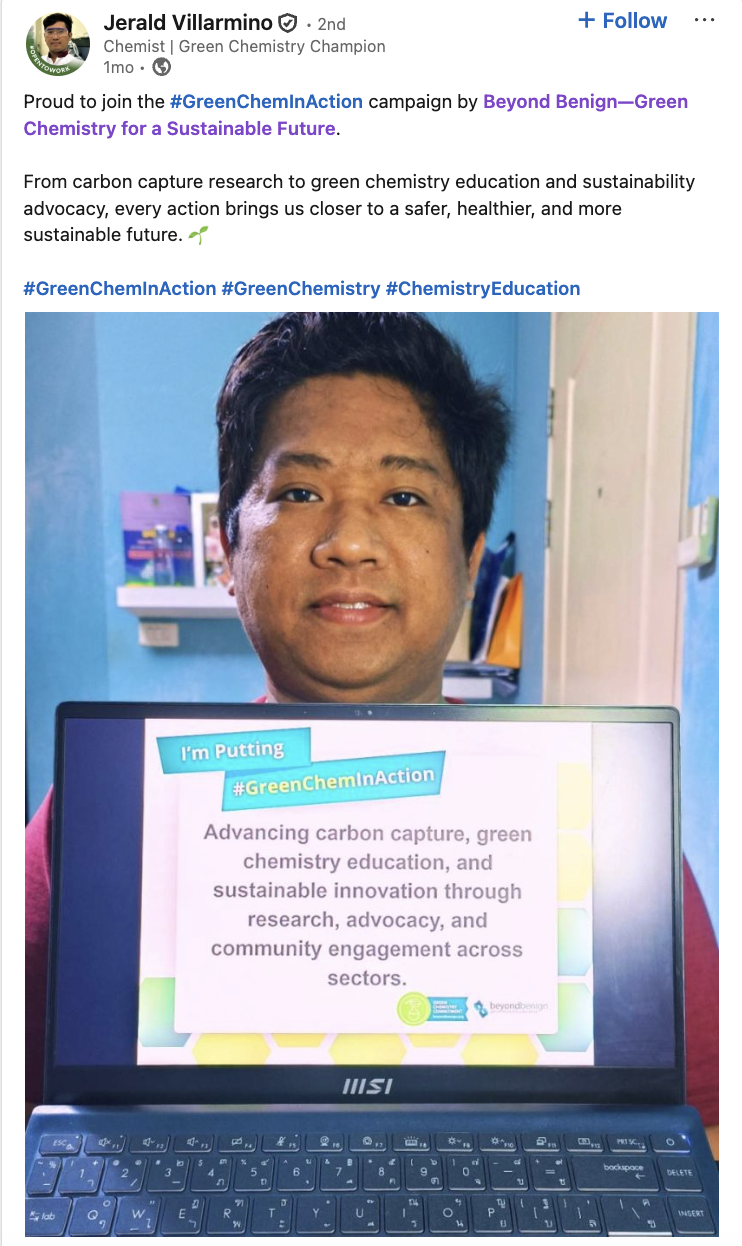
Use the arrows to move between posts. You can also swipe or scroll horizontally through the gallery.
Looking Ahead
The 2026 GCC Summit demonstrated how much momentum is building across the green chemistry education community—and how much becomes possible when educators, researchers, students, and industry leaders work together.
The conversations shared across the virtual and in-person gatherings made clear that scaling green chemistry will require continued collaboration, practical support, and a willingness to keep learning from one another. From redesigning individual laboratory activities to transforming entire curricula and institutions, every step contributes to a larger shift in how chemistry is taught and practiced.
Between Summit gatherings, the Green Chemistry Teaching and Learning Community (GCTLC) offers a year-round space for educators to continue those conversations, exchange resources, find collaborators, and learn from peers around the world. GCC signers can also access an expanding collection of professional development opportunities, teaching tools, and implementation support designed to help turn ideas into action.
For institutions ready to deepen their commitment, becoming a GCC signer provides a framework for advancing green chemistry education while joining a global network working toward the same goal.
The path from principles to practice will look different in every classroom, department, and region. But as the 2026 Summit affirmed, lasting change does not happen in isolation. It grows through shared knowledge, collective action, and a community committed to building a safer and more sustainable future through chemistry.
From Principles to Practice: Reflections from the 2026 GCC Summit
July 22, 2026
Each year, Beyond Benign’s Green Chemistry Commitment (GCC) Summit brings together educators, researchers, industry leaders, and changemakers from around the world to advance a shared vision for chemistry education. In […]
Categories:
How Georgia Gwinnett College Is Building Green Chemistry Into Undergraduate Education
Georgia Gwinnett College is helping expand the conversation around what green chemistry implementation can look like in higher education. A public undergraduate-focused institution in Lawrenceville, Georgia, Georgia Gwinnett College serves a highly diverse student population as both a Minority-Serving Institution (MSI) and a Hispanic-Serving Institution (HSI). In 2023, its chemistry department became the first in Georgia to sign the Beyond Benign Green Chemistry Commitment (GCC), integrating green chemistry principles into coursework, laboratories, student research, and community engagement.
While many publicly visible examples of green chemistry adoption come from large research universities, undergraduate-focused institutions like Georgia Gwinnett College offer an equally important perspective. These institutions often navigate different realities—including high teaching loads, smaller departments, and fewer dedicated research resources—making their strategies especially relevant and transferable for peer institutions exploring similar work.
In this conversation, Dr. Cynthia Woodbridge, professor of chemistry at Georgia Gwinnett College, reflects on the college’s green chemistry journey, the challenges and opportunities of implementing this work at an undergraduate-focused institution, and the role sustainability and inclusion play in shaping the future of chemistry education.
This conversation is the first in a four-part institutional case study series supported through Beyond Benign’s ongoing partnership with MilliporeSigma, the U.S. and Canada Life Science business of Merck KGaA, Darmstadt, Germany. These conversations aim to highlight how green chemistry adoption takes shape across different types of higher education institutions. The series is designed to help prospective and current GCC signers see what implementation can look like on the ground across a broad range of campuses, communities, and institutional structures.
How do you think Georgia Gwinnett College’s identity as an undergraduate-focused institution has shaped the way green chemistry has been implemented on campus?
At Georgia Gwinnett College, our identity as an undergraduate-focused institution has strongly shaped the way green chemistry has been implemented across campus. Because faculty priorities center almost entirely on undergraduate teaching, mentoring, and student development, green chemistry initiatives have been designed with direct student engagement in mind rather than as isolated research efforts.
This focus has encouraged us to integrate green chemistry into coursework, laboratory experiences, undergraduate research projects, and mentoring relationships in ways that are accessible and meaningful for students at different stages of their academic careers. Rather than limiting green chemistry to advanced or specialized courses, we have worked to embed sustainability, systems thinking, and safer chemical practices throughout the curriculum so that a broader range of students can engage with these ideas early and often.
Our undergraduate mission also means that faculty are highly invested in creating research experiences that are both educational and impactful. Many of our green chemistry projects are intentionally structured so students can contribute meaningfully to ongoing work while developing technical skills, critical thinking, and an understanding of chemistry’s broader environmental and societal implications. In this way, green chemistry at Georgia Gwinnett College has evolved not only as a scientific initiative but also as a student-centered educational approach that reflects the college’s core mission.
What first sparked Georgia Gwinnett College’s interest in green chemistry, and who helped move that work forward in the early stages?
The first foray into green chemistry was the implementation of the Georgia Gwinnett College Organic Chemistry I & II Lab Manual published in 2012, which featured greener Organic I experiments and a green semester-long synthesis project (CURE).
Our first Green Chemist was Dr. Joe Sloop, who is retiring this year. I arrived at Georgia Gwinnett College after participating in the last Chemistry Collaborations, Workshops and Communities of Scholars (cCWCS) Green Chemistry event and started working with faculty to create green chemistry opportunities. Work slowed down during COVID, but afterward, our Green Chemistry Task Force was created. Having an active committee helps move things forward.
When Veronica Sublett-Breeden was hired at the College, she immediately began working with the American Chemical Society (ACS) student club and has incorporated green activities into the club.
What role has the Green Chemistry Commitment (GCC) played in the College’s journey, and has signing on helped unlock new opportunities, partnerships, or momentum for the work?
The GCC has played an important role in building momentum for green chemistry at Georgia Gwinnett College. One immediate benefit was access to funding opportunities for signers. In 2024, Georgia Gwinnett College was a recipient of a GC Education Award , which we used to promote awareness of green chemistry across campus.
Signing the Green Chemistry Commitment also strengthened connections to a broader community of educators and practitioners. I have become actively involved in programs offered by Beyond Benign and initiatives developed by the ACS, creating additional opportunities for collaboration, professional development, and curricular growth.
What are some of the biggest barriers or challenges you’ve encountered along the way, and how has the college worked through them?
The process of securing the Commitment fostered meaningful conversations that increased awareness and understanding of the GCC throughout the administration. Persistence and collaboration led to a successful outcome. The Task Force has generated tremendous momentum and a wide range of ideas, creating exciting opportunities that will require thoughtful prioritization as the work continues.
Have there been particular strategies, resources, partnerships, or programs that have been especially valuable in helping your green chemistry efforts succeed?
The Chemistry Department’s inaugural Chair, Dr. Omar Villanueva, is now working at Beyond Benign. We still collaborate with him, and he has been a great resource.
All of us on the Task Force have various collaborations in place: Veronica Sublett-Breeden with the ACS student club, Dr. Kathryn Zimmerman with Beyond Benign, and me with Beyond Benign and the ACS Green Chemistry Institute.
Most recently, we are working on curricular change, which includes a Green Chemistry course, a minor in Green Chemistry, and a focus area in Green Chemistry for our Chemistry majors.
Since green chemistry became more embedded at Georgia Gwinnett College, what changes have you seen for students, faculty, or the institution as a whole?
Since green chemistry became more embedded at the College, we have seen growth in both curricular resources and faculty engagement. For example, a new series of Organic Chemistry II lesson plans was developed that highlights green organic reactions for major functional groups not covered in the textbook. These materials were later shared with the Green Chemistry Teaching and Learning Community (GCTLC).
We have also strengthened connections to green and sustainable chemistry in our online GOB “OB” laboratory courses, helping students see how chemistry concepts relate to sustainability, human health, and real-world applications. We have also made an effort to bring Green Chemistry into our curriculum through our Physical Science courses for non-science majors. Overall, green chemistry has become more visible across the curriculum and has encouraged broader collaboration and resource sharing among faculty.
For faculty or administrators at institutions similar to Georgia Gwinnett College who may feel interested in green chemistry but unsure where to begin, what advice would you give them?
My advice would be to start small and remain consistent. Green chemistry does not need to begin with a complete curriculum redesign. Small changes to laboratory activities, course discussions, or research projects can gradually build momentum over time. It is also important to involve students early, since student interest and enthusiasm can become a powerful voice in demonstrating the value of green chemistry initiatives to the broader institution.
For administrators, the most important step is to support faculty and students who are interested in this work. Providing encouragement, flexibility, and even modest resources can make a significant difference in helping green chemistry initiatives grow into meaningful and sustainable programs.
Get Involved
Interested in bringing green chemistry to your own institution?
- Build your foundation. Explore Beyond Benign’s self-paced online course, An Introduction to Undergraduate Green Chemistry Teaching and Practice, to learn practical strategies for integrating green chemistry into your teaching, aligning with professional standards, and connecting chemistry to sustainability and environmental justice.
- Connect with the community. Join the Green Chemistry Teaching and Learning Community (GCTLC) to access free resources, collaborate with educators, and exchange ideas with peers advancing green chemistry education around the world.
- Take the next step institutionally. Explore the Green Chemistry Commitment (GCC) to learn how your department can formally commit to preparing students for a more sustainable future through green chemistry education.
How Georgia Gwinnett College Is Building Green Chemistry Into Undergraduate Education
June 9, 2026
Georgia Gwinnett College is helping expand the conversation around what green chemistry implementation can look like in higher education. A public undergraduate-focused institution in Lawrenceville, Georgia, Georgia Gwinnett College serves […]
Categories:
2025 Year in Review
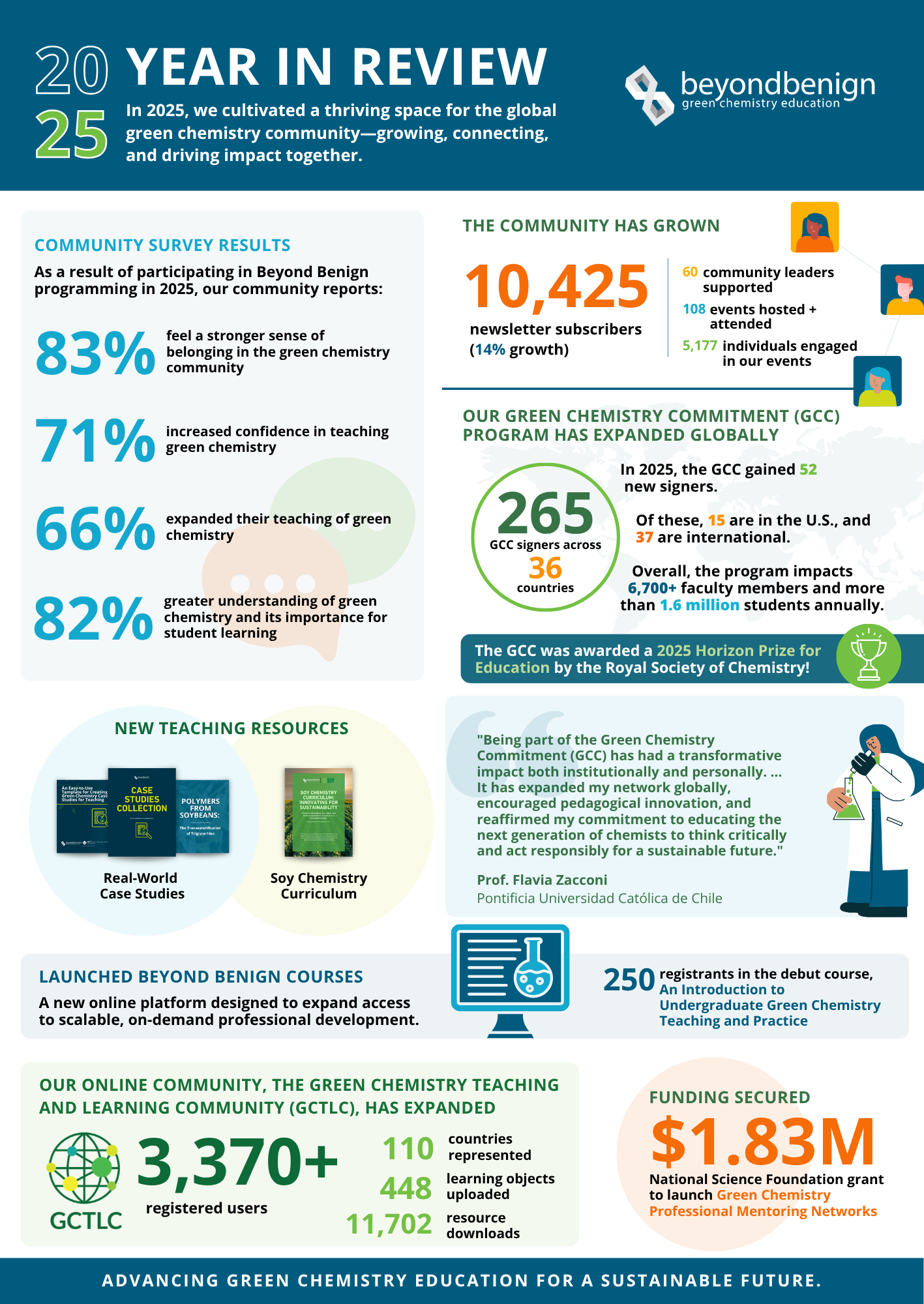
From growing the community to creating new resources, 2025 was an impactful year for Beyond Benign and green chemistry education. Check out key takeaways from our year!
2025 Year in Review
March 24, 2026
From growing the community to creating new resources, 2025 was an impactful year for Beyond Benign and green chemistry education. Check out key takeaways from our year!
Categories:
Expanding the Reach of Green Chemistry: Meet the 2025-2026 GCC Community Ambassadors
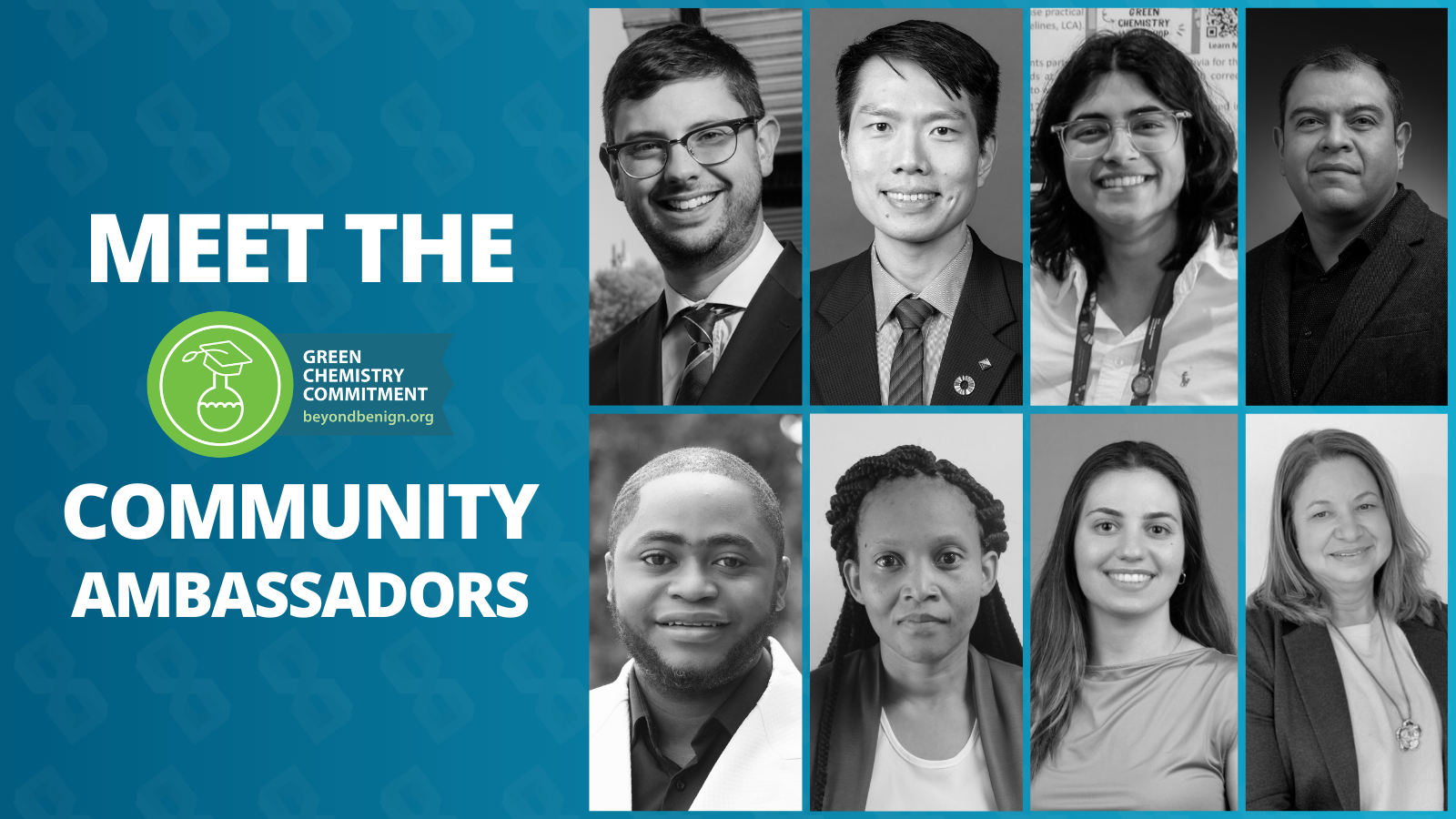
Preparing the next generation of chemists to design safer, more sustainable materials begins in the classroom and laboratory—and requires a global community committed to transforming how chemistry is taught, practiced, and shared.
Through the Green Chemistry Commitment (GCC), institutions of higher education around the world are working together to embed green chemistry principles into education and prepare students to design safer materials and processes for the future.
Recognizing the need to expand this global movement further, Beyond Benign launched the Community Ambassador Program in 2023—an initiative designed to empower educators, researchers, and emerging leaders to advance green chemistry within their institutions and across regions. Since its launch, the program has grown into a globally connected network of ambassadors spanning institutions and continents, each playing a critical role in accelerating institutional adoption, strengthening collaboration, and increasing access to green chemistry education worldwide.
The Community Ambassador Program is distinct in the sense that it is grounded in institutional transformation—supporting long-term integration of green chemistry into curricula, research, and workforce pathways, rather than one-time outreach or awareness efforts. Throughout its implementation, the program has included 16 ambassadors who continue to expand the reach of green chemistry through collaboration, advocacy, and community-building—helping connect educators and institutions to the global GCC network, the Green Chemistry Teaching and Learning Community (GCTLC), and additional Beyond Benign initiatives aimed at supporting educators to advance green chemistry globally.
Below, meet this year’s Community Ambassadors and learn how they’re helping grow the green chemistry community worldwide.
Inspired by their work? You may want to consider becoming a Community Ambassador yourself!
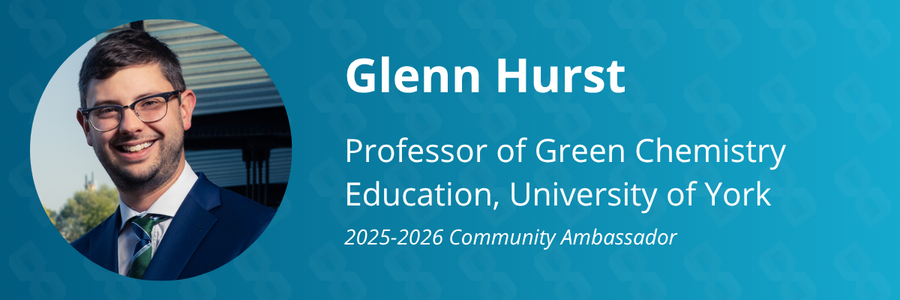 Prof. Glenn Hurst has spent his career advancing green and sustainable chemistry education. A professor at the University of York’s Green Chemistry Centre of Excellence, his work focuses on integrating systems-thinking approaches into chemistry education to help students understand the broader environmental and societal impacts of chemical design.
Through his role as a GCC Ambassador, Glenn helps expand awareness of green chemistry education initiatives and encourages institutions to engage with the growing global community.
He has been particularly proud to support engagement with the GCTLC, which connects educators and researchers working to advance green chemistry education around the world. As part of his ambassador work, Glenn also introduces new audiences to the GCC, helping institutions explore how they can integrate sustainability principles into their chemistry programs.
For Glenn, the role reflects a broader goal: helping ensure that green chemistry principles are embedded across chemistry so that the next generation of scientists is equipped to design safer, more sustainable solutions.
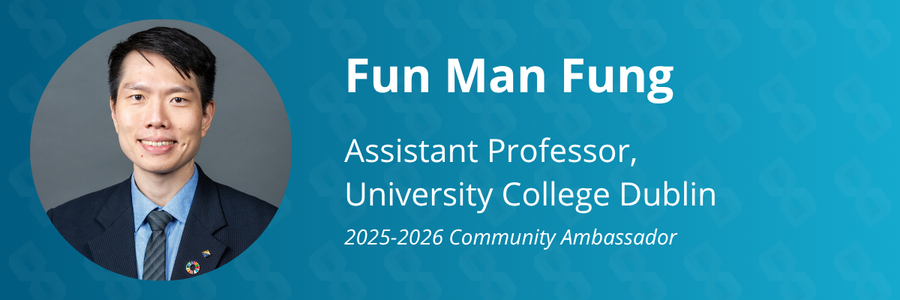 Prof. Fun Man Fung has built a career at the intersection of chemistry education, global collaboration, and sustainability. Trained as a chemistry researcher and educator at the National University of Singapore and Technische Universität München, he has worked with institutions and scientific communities worldwide to strengthen chemistry education and interdisciplinary collaboration.
As a GCC Ambassador, Fun Man sees his role as helping expand the global conversation around green chemistry and bringing more educators and institutions into the community.
One of his proudest accomplishments so far has been helping introduce the GCC to colleagues in Taiwan. In 2024, Fun Man spoke at the Systems Thinking Symposium during the Chemistry National Meeting in Tamkang, where he shared Beyond Benign’s vision for advancing green chemistry education.
The response was immediate: One institution has already signed the GCC, and several others are currently exploring the process. “Bringing this global movement to my colleagues in Taiwan has been incredibly rewarding,” he says. “It shows that the desire for green chemistry is universal—it just needs a spark.”
For Fun Man, ambassador work often happens through everyday conversations: at conferences, through social media, or in discussions with colleagues around the world. Each interaction, he says, is an opportunity to introduce someone new to the possibilities of green chemistry and invite them into the community.
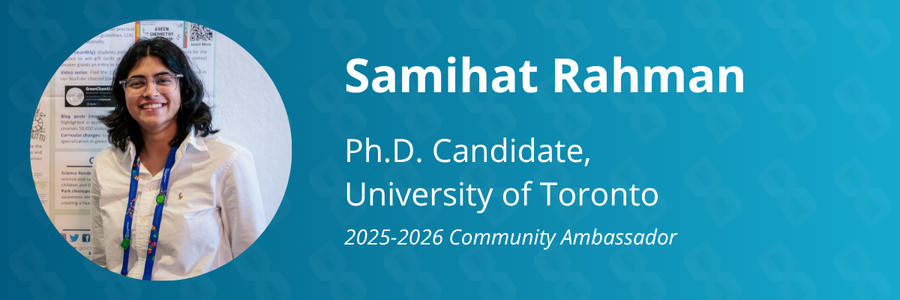 Samihat Rahman is a Ph.D. candidate in physical chemistry at the University of Toronto. Her research combines spectroscopy, materials synthesis, and quantitative analysis to better understand and optimize complex chemical systems.
Alongside her research, Samihat has been actively involved in the student-led Green Chemistry Initiative at the University of Toronto, helping promote sustainable practices in chemistry and foster collaboration between students, researchers, and industry partners.
Samihat became a Community Ambassador to help spread awareness of green chemistry and connect more students and researchers with the global community working to advance sustainable chemistry.
She has especially enjoyed participating in Green Chemistry Connections, Beyond Benign’s webinar series that brings together educators and researchers from around the world. The program has allowed her to meet new collaborators and learn about different approaches to green chemistry across regions and institutions.
Samihat has also helped promote the Green Chemistry Connections webinar series within her university, introducing more students and researchers to the green chemistry community. She hopes to continue raising awareness of green chemistry both at her current institution and at her alma mater.
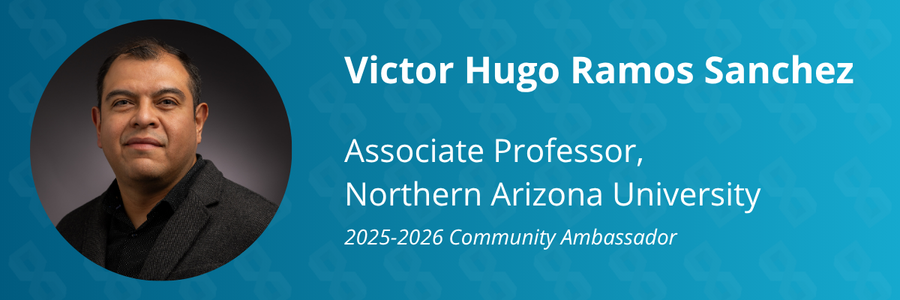 Prof. Victor Hugo Ramos Sánchez brings a global perspective to green chemistry education and research. He earned his Ph.D. in chemistry from the University of Sheffield in the United Kingdom and previously served as a professor at the Autonomous University of Chihuahua in Mexico before joining Northern Arizona University in 2023.
His research focuses on developing sustainable materials and processes for hydrogen production and fuel cells, as well as advancing greener routes for chemical synthesis and analysis. Through this work, he has built a career centered on applying chemistry to real-world sustainability challenges.
Victor was inspired to become a GCC Ambassador after seeing the dedication of the Beyond Benign team to advancing green chemistry education worldwide.
He was particularly motivated by the opportunity to expand awareness of the GCC among Spanish-speaking institutions in Latin America, where the initiative has strong potential to grow.
One of his first initiatives was identifying undergraduate chemistry programs across Mexico and reaching out to them directly to share information about the GCC and its benefits.
Earlier in his career in Mexico, Victor established a research group focused on green chemistry and worked with university leadership to integrate sustainability concepts into the chemistry curriculum—efforts that continue to shape his work as a GCC Community Ambassador today.
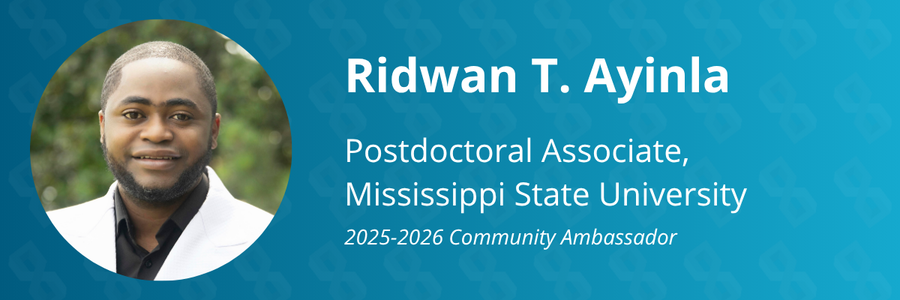 Ridwan Ayinla works at the intersection of materials science, electrochemistry, and energy storage safety. With years of experience in sustainable materials synthesis and battery engineering, his research focuses on improving the safety and resilience of next-generation energy storage systems.
Through his work on battery materials and system-level safety performance, Ridwan has seen firsthand how chemical design decisions influence environmental impact and technological sustainability.
That perspective helped inspire his involvement in green chemistry outreach.
As a Community Ambassador, Ridwan focuses on raising awareness of green chemistry principles and encouraging scientists and students to integrate sustainability into their research and education.
Through seminars, discussions, and online engagement—including outreach in both Mississippi and Nigeria—he has worked to broaden conversations about sustainable chemical design and connect more researchers with the global green chemistry community.
He has also explored ways to incorporate green chemistry concepts into existing science curricula, helping ensure that students encounter sustainability-focused chemical design early in their scientific training.
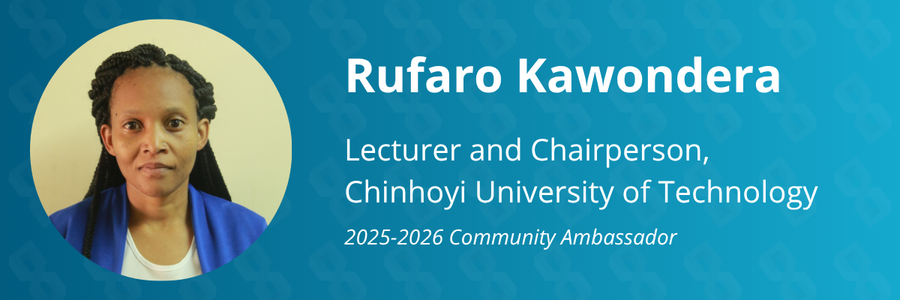 Dr. Rufaro Kawondera is a researcher and lecturer at Chinhoyi University of Technology in Zimbabwe. She earned her Ph.D. in engineering sciences and studies nanomaterials and sustainable energy technologies.
Alongside her research, Rufaro is deeply committed to building stronger scientific communities and expanding access to sustainability-focused education.
She was inspired to become a GCC Ambassador by a passion for mentorship, knowledge sharing, and community development.
Her efforts have focused on expanding the green chemistry community in Zimbabwe, where five universities are now engaged in green chemistry initiatives through the GCC program.
Rufaro has helped connect institutions, researchers, and students interested in sustainability and plans to continue growing the community beyond Zimbabwe’s borders. She is also helping organize a Green Chemistry Challenge in which students will present innovative solutions based on green chemistry principles.
In her own teaching, Rufaro integrates green chemistry concepts into her courses and highlights sustainability in scientific talks and presentations. Beyond the classroom, she shares opportunities and resources through professional networks and online platforms, encouraging more researchers to engage with the global green chemistry community.
 Yasmeen Jaberi is a graduate student at McGill University who is passionate about making science more accessible beyond the lab.
For Yasmeen, becoming a Community Ambassador has been an opportunity to talk more intentionally about green chemistry and help others rethink what the field of chemistry can be.
Yasmeen is looking forward to participating in the upcoming 11th Annual GCM x GCI Symposium: Lab to Landfill at McGill, which will explore the impact of everyday decisions on chemical waste. She also plans to continue working with McGill’s chemistry outreach group, helping integrate green chemistry concepts into public engagement activities.
She believes the growth of the green chemistry movement depends on steady, long-term education and outreach.
Through conversations with high school students, undergraduates, and members of the public, Yasmeen hopes to encourage more creative thinking about the scientific challenges of our time—and to help expand the green chemistry community one conversation at a time.
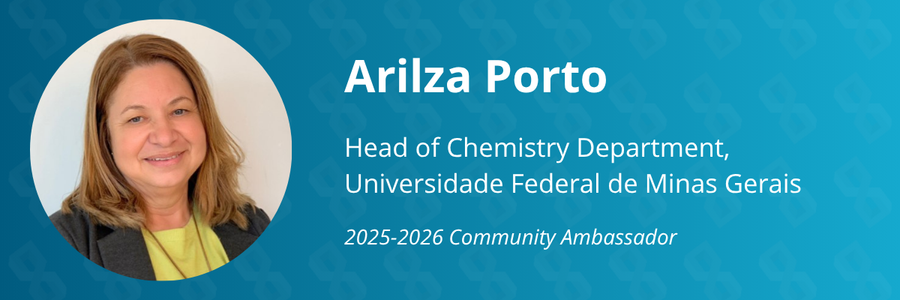 Prof. Arilza Porto is the Head of the Chemistry Department at the Universidade Federal de Minas Gerais in Brazil, where she works to advance green chemistry education and strengthen collaboration within the scientific community.
For Arilza, collaboration and community-building have always been central to her work. Through the GCC Ambassador role, she aims to amplify voices, support the growth of others, and help strengthen the global green chemistry community.
One initiative she is especially proud of at her institution is the restructuring of practical chemistry classes, which serve more than 5,000 students each year. The effort has helped reduce resource use while also emphasizing the importance of designing sustainable solutions to chemical problems.
Arilza and her colleagues have also been actively working to expand awareness of green chemistry within their institution and beyond. Through regular meetings with chemistry professors, department heads, and educational administrators, they are introducing the GCC and encouraging the integration of green chemistry principles into undergraduate curricula.
Through these efforts, Arilza hopes to help build stronger connections across institutions and ensure that sustainability becomes an integral part of chemistry education for future generations.
Get Involved
The Green Chemistry Commitment (GCC) continues to grow as more educators, researchers, and institutions join the movement to redesign chemistry for sustainability.
Interested in learning more or participating?
- Meet the 2024 Community Ambassadors
- Learn how your institution can become a Green Chemistry Commitment (GCC) Signer
- Apply to become a Community Ambassador
- Join the Green Chemistry Teaching and Learning Community (GCTLC) to connect with educators, researchers, and leaders advancing green chemistry worldwide
Together, these efforts are helping build a global community committed to shaping a safer, more sustainable future through chemistry.
Expanding the Reach of Green Chemistry: Meet the 2025-2026 GCC Community Ambassadors
March 23, 2026
Preparing the next generation of chemists to design safer, more sustainable materials begins in the classroom and laboratory—and requires a global community committed to transforming how chemistry is taught, practiced, [...]Categories:
Announcing the 2026 Green Chemistry Education Award Winners
Across the globe, chemistry classrooms are changing.
Through the Green Chemistry Education Awards, made possible through the generous support of Millipore Sigma (MilliporeSigma is the U.S. and Canada Life Science business of Merck KGaA, Darmstadt, Germany) and Dow, Beyond Benign is honored to support educators and institutions working to embed sustainability more deeply into chemistry education and advance the Green Chemistry Commitment’s (GCC) Student Learning Objectives—a framework guiding institutions in integrating green chemistry across curriculum, research, and community engagement. As part of a global network of colleges and universities, these award-winning GCC signers are integrating green chemistry principles across their curricula and preparing students for more sustainable scientific practice.
This year’s recipients are redesigning legacy lab experiments, introducing greener technologies, launching student sustainability hubs, strengthening teacher preparation programs, and building entirely new pathways for students to engage with green chemistry from their first year through graduation.
Spanning six continents, this year’s awardees reflect the growing global momentum to transform how chemistry is taught, practiced, and connected to sustainability challenges.
Through safer laboratory practices, measurable reductions in resource use, innovative curriculum design, and empowered students who see environmental responsibility as central to scientific practice, this year’s awardees demonstrate what meaningful transformation looks like in action.
Collectively, this year’s awards will impact thousands of students annually through redesigned laboratory experiences, faculty training, and new sustainability-focused learning pathways.
University of San Francisco
At the University of San Francisco, green chemistry is expanding into upper-division coursework. With support from this award, faculty will develop and pilot a new Experimental Biochemistry laboratory focused on the enzymatic synthesis of molecules such as capsinoids and indican, illustrating principles such as less-hazardous synthesis, safer solvents, and catalysis. The team will also create two biochemistry case studies and host a seminar speaker to strengthen connections between green chemistry and biochemistry across campus. Materials will later be shared through the Green Chemistry Teaching and Learning Community (GCTLC).
From the team at USF: “Funding from this award will enable us to make a concerted effort to develop green chemistry materials for our Biochemistry classes. While we have integrated concepts of green chemistry and sustainability into our lower-division lectures and labs for several years, we can now extend this commitment further into our upper-division classes, primarily Biochemistry. This area of the curriculum reaches all of our Chemistry majors as well as a significant number of Biology and pre-health students, making it a strategic focal point for expanding the impact of green chemistry education.”
Universidad de San Carlos de Guatemala
At the Universidad de San Carlos de Guatemala, second-year organic chemistry students will explore mechanochemistry as a greener alternative to traditional synthesis. The project introduces solvent-free extraction of natural products and chitosan from shrimp shell waste, reinforcing sustainable synthesis and waste valorization. Faculty and teaching assistants will receive training, and students will compare traditional and green methodologies throughout the academic year.
From the team at Universidad de San Carlos de Guatemala: “This award is incredible news for our university! With this recognition, we will be able to introduce greener alternatives to create products and materials, while teaching our students that there are safer and more benign ways to carry out chemical reactions. This award will boost our green chemistry transformation and strengthen our commitment to sustainability in education and research.”
Chimie Verte Academy – Université Savoie Mont Blanc
Université Savoie Mont Blanc will launch the “Passport to the Green Chemistry Academy,” a structured pathway spanning L1–L3 designed to introduce undergraduates to green chemistry early and progressively. Through digital content, motion design videos, case studies, quizzes, industry visits, and roundtables with professionals, students will gain both theoretical grounding and real-world exposure. Digital badges aligned with GCC Student Learning Objectives will formally recognize their progress. The program will be piloted locally before expanding to partner universities.
From the team at Université Savoie Mont Blanc: “Because of this award, students will be exposed to green chemistry much earlier in their academic journey and will better understand how chemistry can address real sustainability challenges. Through the Passport to the Green Chemistry Academy, they will gain concrete experiences, digital recognition (badges), and direct interaction with researchers, industry, and master’s students. This will empower them to make informed choices about their studies and future careers in green chemistry.”

Akwa Ibom State Polytechnic, Nigeria
Akwa Ibom State Polytechnic will host a two-day flagship green chemistry program focused on both faculty development and student innovation. Faculty and laboratory staff will receive training in curriculum redesign, safer laboratory practices, and systems thinking. Students will launch the Student Sustainability Accelerator Hub (SSAH), engaging in innovation challenges, mentorship, and peer-led sustainability initiatives that encourage practical, low-cost green solutions.
From the team at Akwa Ibom State Polytechnic: “This award will expose our students to safer, more sustainable laboratory practices and empower them through peer-led innovation challenges and mentorship. It is our hope that this initiative will help them to grow into a new generation of environmentally conscious scientists and sustainability innovators.”
Federal University of Minas Gerais (UFMG)
At the Federal University of Minas Gerais, sustainability will become visible—and measurable—in undergraduate teaching laboratories. The university will install waterless condensers and water-recycling systems to replace conventional water-cooled apparatus, thereby significantly reducing water consumption. Faculty and technical staff will receive training to ensure long-term use and maintenance, and water usage will be monitored to quantify environmental impact and cost savings.
From the team at UFMG: “This award will have a transformative impact on our undergraduate chemistry laboratories by enabling hands-on implementation of green chemistry principles at scale. By reducing water consumption and modernizing laboratory infrastructure, our students will directly experience how sustainability and high-quality chemical education go hand in hand. This project will empower future scientists to integrate environmental responsibility into their professional practice.”
University of Groningen
The University of Groningen is taking a data-driven approach to sustainable laboratory behavior. Through a controlled study across 12 teaching labs, the team will test behavioral interventions designed to increase students’ confidence in acting sustainably and strengthen positive lab norms. Students will set SMART (specific, measurable, achievable, relevant, and time-bound) sustainability goals, use checklists, and collaborate on collective objectives, while researchers monitor energy use, water consumption, chemical waste, and consumables to measure impact.
From the team at University of Groningen: “The award allows us to demonstrate, in measurable terms, how educational labs can genuinely reduce their footprint without compromising learning outcomes. Our proposal combines behavioral interventions from environmental psychology with objective laboratory metrics. This integration offers a unique opportunity to establish an evidence base that connects educational practices, behavioral change, and quantifiable environmental benefits.”
Chinhoyi University of Technology
Chinhoyi University of Technology will convene a Green Chemistry and Sustainability Challenge engaging three faculties and hundreds of students. Participants will identify current processes or products that can be improved through green and sustainable approaches, developing practical solutions that emphasize innovation, teamwork, and systems thinking. The initiative also includes participation in GreenChemAfrica to strengthen regional collaboration.
From the team at Chinhoyi University of Technology: “This award will benefit my students by strengthening their training in green chemistry and sustainable scientific practice. Our proposed project will provide students with a practical platform to design and test environmentally friendly chemical processes, encouraging innovation, teamwork, and critical thinking.”
University of Washington Bothell
At the University of Washington Bothell, first-year chemistry students will participate in community-engaged green chemistry research directly within their general chemistry laboratory courses. Advanced undergraduates and faculty will develop a Course-Based Undergraduate Research Experience (CURE) aligned with the GCC Student Learning Objectives. Students will monitor North Creek, a local waterway on campus, connecting laboratory learning to environmental stewardship and institutional sustainability efforts.
From the team at University of Washington Bothell: “This award will allow our students to participate in community-engaged green chemistry research directly within their general chemistry laboratory courses. Integrating a Course-Based Undergraduate Research Experience (CURE) into a first-year class provides a high-impact learning opportunity at the very start of students’ academic journeys. Because CUREs have been shown to increase students’ confidence and persistence in STEM fields, embedding this model in an introductory course ensures that these benefits reach a broader and more diverse group of students.”
Harvey Mudd College
Harvey Mudd College will develop and implement a new multi-part green polymer and bioconjugation experiment in its Organic I laboratory course. Students will synthesize and functionalize polymers using safer reagents and greener solvents, reflect on sustainability considerations, and characterize their products using advanced analytical techniques. The work will be presented at the Green Chemistry Gordon Research Conference and shared more broadly to support adoption by other institutions.
From the team at Harvey Mudd College: “This grant will enable our team of students and faculty to develop a new, multi-part green chemistry experiment for our organic laboratory course focused on the synthesis and functionalization of polymers. It will also help us share this innovative work at an international green chemistry conference and publish it so other green chemists can use it in their own courses.”
University of Hawai‘i Maui College
The University of Hawai‘i Maui College will deepen green chemistry integration across its curriculum by implementing new green laboratory modules. Faculty participation in the 49th RASBQ Conference in São Paulo will support global engagement and inform the development of modern, engaging instructional materials that emphasize safer laboratory practices and sustainability.
From the team at University of Hawaii Maui College: “This award provides helpful support for our efforts to integrate sustainable science at UHMC. It assists in our transition toward safer laboratory practices and helps ensure our students are exposed to environmentally responsible chemistry.”
University of California, Berkeley
At the University of California, Berkeley, the focus is on preparing future science teachers. The team has designed an online unit that integrates green chemistry and laboratory safety for preservice educators. The unit will be piloted, assessed, and refined through a design-based research cycle, with validated tools measuring gains in green chemistry knowledge, lab safety understanding, and teaching confidence. Classroom observations will help evaluate how green chemistry can be implemented effectively to support student learning.
From the team at UC Berkeley: “This grant will help support pre-service science teachers in not only learning valuable lab safety skills through tangible examples, but learning how green chemistry and lab safety support each other and how they can easily be integrated into existing curricula. Through studying how pre-service teachers are learning lab safety and green chemistry, we aim to build on the existing work and guidance for lab safety and green chemistry courses to continue to improve science education for all.”
How to get involved:
- Not yet a Green Chemistry Commitment (GCC) signer? Bring the GCC to your higher ed institution to unlock opportunities for professional development, funding, and more while expanding green chemistry education.
- Subscribe to the Beyond Benign newsletter to be notified when applications open for the next batch of Green Chemistry Education Awards and stay up to date on other funding opportunities.
- Read more inspiring, replicable stories of green chemistry education in action.
Announcing the 2026 Green Chemistry Education Award Winners
February 23, 2026
Across the globe, chemistry classrooms are changing. Through the Green Chemistry Education Awards, made possible through the generous support of Millipore Sigma (MilliporeSigma is the U.S. and Canada Life Science [...]Categories:
From Our Community: A Personal Reflection of My Journey in Green Chemistry and Collaboration With Beyond Benign
 We are inspired by this reflection from community member Seyed Mosayeb Daryanavard, Assistant Professor of Analytical Chemistry at the University of Hormozgan (Iran) and a visiting researcher at Chiang Mai University (Thailand). In 2024, Seyed helped bring the Green Chemistry Commitment (GCC) to the University of Hormozgan, supporting the Department of Chemistry in integrating green chemistry principles and practices into its curriculum. Read more about Seyed’s green chemistry journey below!
Contributed by Seyed Mosayeb Daryanavard
My engagement with green chemistry did not begin with a formal project or an organizational requirement. It began much earlier, during my graduate studies, a path deeply influenced by the specific environmental conditions of southern Iran. Living on an Island (Qeshm) and coastal area like Bandar Abbas, where marine pollution, industrial activities, water scarcity, and ecosystem fragility are part of everyday reality, meant that chemistry never remained a purely theoretical science for me. Gradually, this simple but persistent question emerged: What kind of chemistry do we study, teach, and apply, and what impact does this chemistry have on the environment and society?
In the early years of my academic career in the chemistry department at the University of Hormozgan, green chemistry was not yet a structured part of the curriculum. However, I became increasingly interested in concepts such as waste prevention, the use of safer solvents, and environmentally friendly analytical methods. This interest gradually shaped not only my research path, but also my overall view of chemistry education. Over time, green chemistry became more than a research topic for me; it became a framework through which I evaluated laboratory practices, educational priorities, and the social responsibility of universities.
My collaboration with Beyond Benign was an important turning point in transforming these individual concerns into a collective and institutional effort. For the University of Hormozgan, joining Beyond Benign’s Green Chemistry Commitment (GCC) was not merely a symbolic act; it provided us with a common framework, a common language, and a sense of belonging to a global community that truly believes in the transformative power of green chemistry education. As the coordinator, I have seen firsthand how Beyond Benign functions not as an external observer but as a supportive partner for local change.
One of the most valuable aspects of working with Beyond Benign was that it encouraged us to think systematically, not as a piecemeal effort. Rather than seeing green chemistry as simply an “add-on” to existing courses or projects, we were encouraged to rethink the foundations of chemistry education and research. This perspective has led to deeper conversations within the chemistry department, among faculty and students, about the long-term implications of our choices in teaching, thesis guidance, and research design.
Over the past few years, this collaboration has led to tangible and meaningful changes in the chemistry department at the University of Hormozgan. Graduate research has become a particularly effective platform for implementing the 12 Principles of Green Chemistry. Between 2020 and 2025, more than 30 master’s theses directly incorporated one or more green chemistry principles, including the use of renewable resources, plant-based nanomaterials, heterogeneous catalysis, safer solvents, and environmental pollution monitoring related to regional challenges. Importantly, these projects were not imposed in a prescriptive manner, but rather emerged from conversations with students. Many students gradually came to see green chemistry not as a limitation but as a scientifically rich and socially meaningful approach. At the faculty level, the Beyond Benign framework also helped foster interdisciplinary collaboration. Researchers working in environmental monitoring, catalysis, nanomaterials, sustainable solvents, analytical chemistry, and chemistry education increasingly saw their work as interconnected components of a shared vision of sustainability.
For me, this period coincided with a deeper focus on green analytical chemistry, particularly in the development and application of green assessment tools such as AGREEprep. A central question gradually shaped my research path; one that still guides my work: How can the “greenness” of analytical methods be assessed quantitatively, transparently, and scientifically, without sacrificing analytical performance?
Education was another area where the impact of Beyond Benign was clearly visible. Courses such as Green Chemistry and the Environment, Green Analytical Chemistry, and Green Organic Synthesis were gradually revised to create a stronger link between theoretical principles and practical laboratory experience. Redesigning experiments to replace hazardous solvents with water, ionic liquids, or deep eutectic solvents was not always easy, especially given resource constraints. However, the educational value of these changes, both in terms of student safety and shaping their attitudes, was abundantly clear. The Beyond Benign philosophy assured us that even small, incremental changes can have lasting effects.
My journey in green chemistry did not end at the University of Hormozgan. Motivated to further develop my expertise in green analytical chemistry and sustainability assessment, I took the next step by joining Chiang Mai University, northern Thailand. This move allowed me to experience new research horizons, interact with new academic environments, and expand my work on green indicators, sustainability metrics, and comprehensive assessment frameworks. Encountering new colleagues, students, and academic cultures reaffirmed my belief that green chemistry thrives above all through dialogue and cross-border engagement.
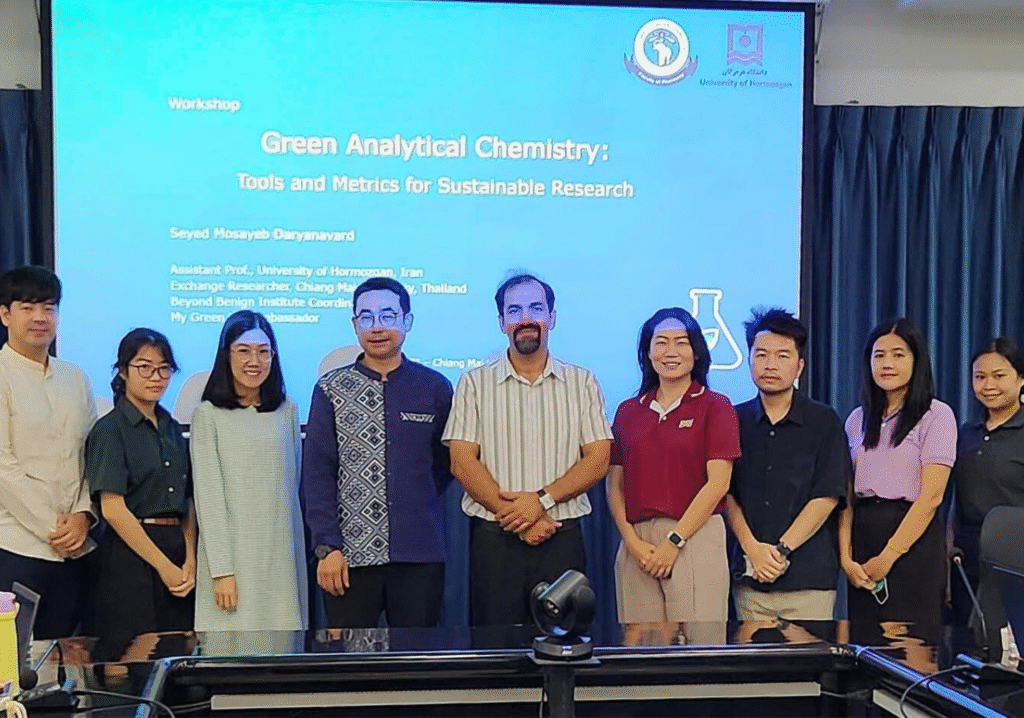
Seyed Mosayeb Daryanavard (center) and Prof. Chalermpong Saenjum’s research group at a Green Analytical Chemistry Workshop at Chiang Mai University.
Continuing this path led to another milestone: being honored with an invitation from Prof. Muftah El-Nass to serve as a keynote speaker at the Qatar University Green Chemistry Symposium in December 2025. For me, this invitation was not only an academic honor but also a personal confirmation of the coherence and meaning of this path, from local activities at the University of Hormozgan to participation in international dialogues. This experience demonstrated that a sustained commitment to green chemistry and analytical chemistry, along with the support of our institutions, Beyond Benign can pave the way for new conversations and collaborations.
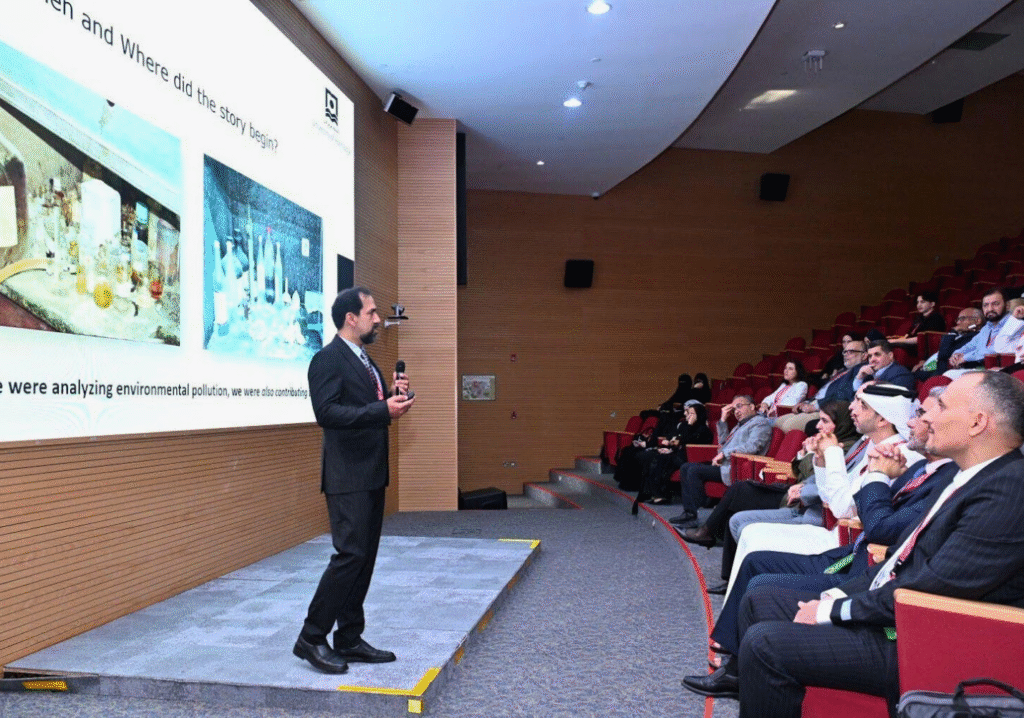
Seyed Mosayeb Daryanavard speaking at the Green Chemistry Symposium at Qatar University.
On a more personal level, working with Beyond Benign has also changed the way I view the role of a faculty member. Today, I see myself not simply as a researcher or lecturer, but as a mediator between the global principles of sustainability and the local realities of higher education. Beyond Benign’s support, flexibility, and openness to diverse institutional contexts created a space where experimentation, rethinking, and incremental progress were not only permitted but encouraged.
When I look back over the years, I see progress not just in the number of courses, theses, or reports, but in changing attitudes. Green chemistry at the University of Hormozgan is no longer an abstract or imported concept, but has become a practical, indigenous approach shaped by the environmental needs of the region and the scientific capacities of the university. This experience also explains why I continue to focus on developing green assessment matrices today: Without transparent and reliable tools to measure progress, even the sincerest green efforts may go unnoticed.
My motivation to continue on this path and to continue working with Beyond Benign stems from a shared understanding: that green chemistry is not a final, fixed paradigm, but a dynamic, evolving process. It is kept alive by continuous learning, engaging with new people, and forming new partnerships. I am eager to continue on this path, take on new challenges, and seek to build partnerships that contribute to a more responsible, reflective, and sustainable future for chemistry.
— Seyed Mosayeb Daryanavard
Assistant Prof., University of Hormozgan, Iran
Visiting Researcher, Chiang Mai University, Thailand
s.m.daryanavard@gmail.com
How to get involved:
- Connect with Seyed Mosayeb Daryanavard on the Green Chemistry Teaching and Learning Community (GCTLC), a free online platform for connecting with the global community.
- Not yet part of the Green Chemistry Commitment (GCC)? Learn how your institution can become a signer and provide students with essential skills and training for today’s workforce.
- Subscribe to Beyond Benign’s newsletter for the latest updates from the green chemistry community.
From Our Community: A Personal Reflection of My Journey in Green Chemistry and Collaboration With Beyond Benign
February 5, 2026
We are inspired by this reflection from community member Seyed Mosayeb Daryanavard, Assistant Professor of Analytical Chemistry at the University of Hormozgan (Iran) and a visiting researcher at Chiang Mai […]
Categories:
Designing Chemistry for Global Challenges: Expert Perspectives
 Learn from experts in the field who are leading the charge to solve world needs through chemistry.
Chemistry doesn’t just shape technologies; it shapes outcomes. It influences who has access to energy, how medicines are produced, what risks workers and communities are exposed to, and how long materials persist in the environment. In a moment of overlapping climate, health, and industrial challenges, how chemistry is practiced matters as much as what it makes.
Promoting Chemistry Applied to World Needs is a webinar series developed in collaboration with the IUPAC Committee on Chemical Research Applied to World Needs (CHEMRAWN). The series brings together researchers, educators, practitioners, and members of the public who are interested in how chemistry can be directed toward solving real-world problems—not in the abstract, but at the scale of systems, industries, and societies.
Across the series, speakers situate their work within global frameworks such as the United Nations Sustainable Development Goals and IUPAC’s Top 10 Emerging Technologies, highlighting the role chemists play in shaping safer, more sustainable futures. Each session examines concrete decision points where science, policy, and practice intersect, offering insight into how green chemistry principles move from research into action.
Explore the recordings below.

From Detoxifying Chemical Warfare Agents to Treating Nuclear Wastewater: Adventures in the Synthesis of Metal-Organic Frameworks
What if chemists could design materials specifically to meet the world’s most urgent challenges? In this opening webinar, Prof. Ashlee Howarth (Concordia University) introduces metal-organic frameworks (MOFs)—materials whose structure can be tuned to address issues like toxic pollution, chemical safety, and nuclear contamination—as a powerful platform for problem-solving. Grounded in real research and global need, this talk offers a compelling look at how advanced materials science connects directly to human and environmental well-being.
What Is Carbon Neutrality, and How to Achieve It?
Carbon neutrality is more than a climate goal—it’s an energy challenge with enormous economic and social implications. In this webinar, Prof. Junji Nakamura (Kyushu University) lays out a clear, systems-level view of where emissions actually come from and what it would take to eliminate them. He makes the case for solutions that can scale globally, especially in developing regions, and explores how chemistry, policy, and public will must work together if carbon neutrality is to move from aspiration to reality.
Atomic-Scale Insights into Energy Materials (Batteries Included!)
What do electric vehicles, next-gen solar cells, and even a world-record lemon battery have in common? In this lively talk, Prof. Saiful Islam (University of Oxford) connects the climate and energy challenge to the place where breakthroughs actually happen. With clarity, humor, and real-world relevance, he shows how looking at the atomic scale helps explain what makes batteries charge faster (or fail), why solar cells are advancing so quickly, and how modeling + experiments together can accelerate clean-tech progress. If you want an accessible window into the science powering the energy transition—and why the details inside materials matter so much—this recording is a fun, smart watch.
Affordable, Equitable Clean-Water Availability: A Materials-Based Approach
Access to safe drinking water is one of the most urgent and unevenly distributed challenges of our time. In this talk, Prof. Chandramouli Subramaniam (Indian Institute of Technology Bombay) explores how materials science can help close that gap, focusing on low-energy, solar-driven approaches to producing freshwater from contaminated and saline sources. Grounded in real-world constraints such as cost, durability, and scalability, the session offers a compelling look at how chemistry can support more equitable access to clean water, especially in regions facing acute water stress.
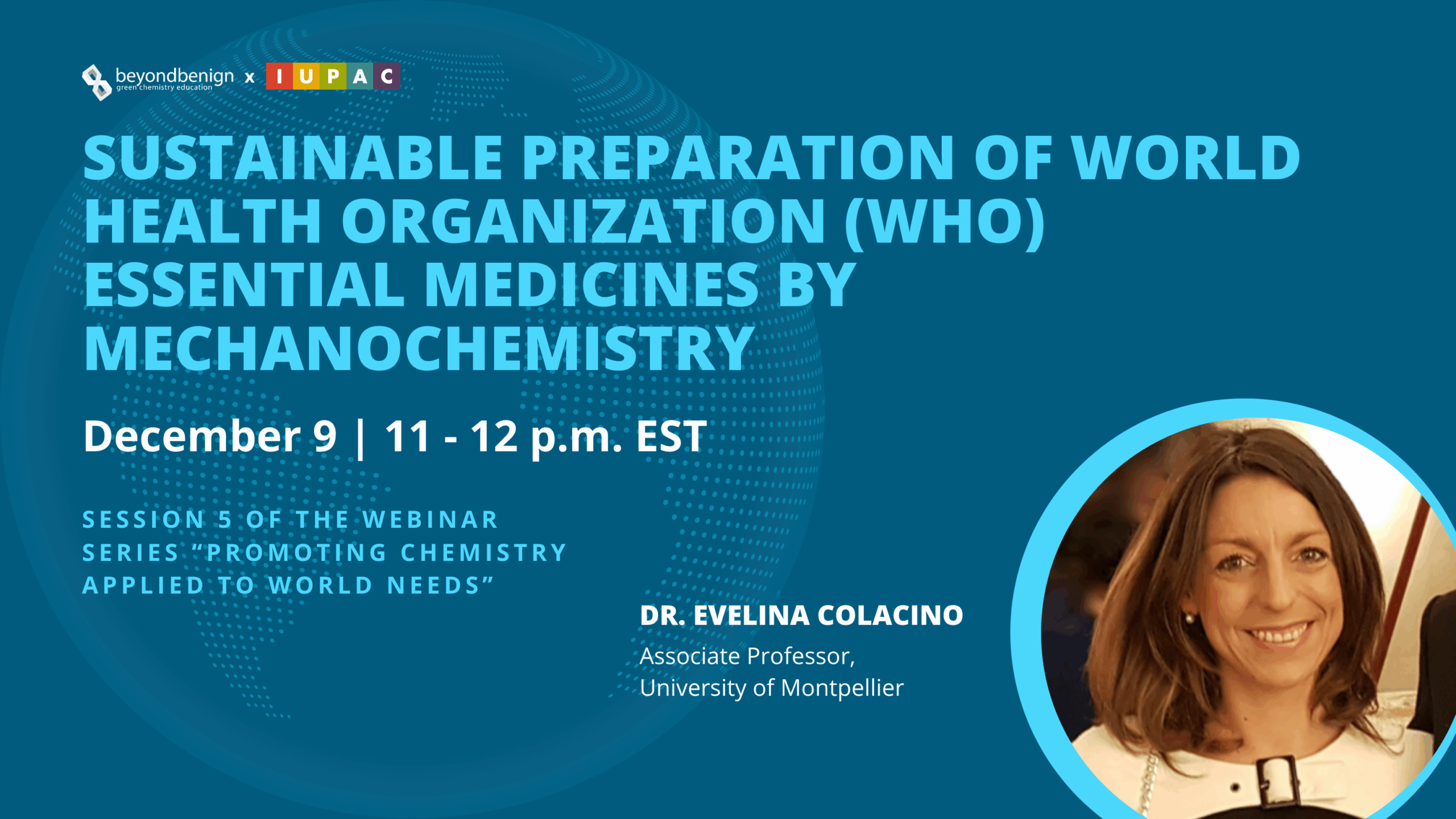 Sustainable Preparation of World Health Organization (WHO) Essential Medicines by Mechanochemistry
Modern pharmaceutical manufacturing depends heavily on organic solvents — a choice with major energy, cost, and environmental consequences. In this webinar, Prof. Evelina Colacino (University of Montpellier) explores how mechanochemistry can reduce that reliance, enabling the preparation of WHO essential medicines with fewer resources and less waste. The result is a practical, systems-level look at how greener chemistry can reshape how medicines are made.
For proprietary reasons, Prof. Evelina Colacino’s presentation is not available for public viewing. For further information on Mechanochemistry, please visit https://edu.mechanochemistry.eu or contact Evelina directly.
Dive Deeper
-
- Join the Green Chemistry Teaching and Learning Community to discuss what you learned in these recordings, access resources, join conversations, and connect with your peers from across the globe!
- Learn more about the Chemical Research Applied to World Needs (CHEMRAWN) committee of IUPAC and join their LinkedIn group to keep up with their news, projects, and initiatives!
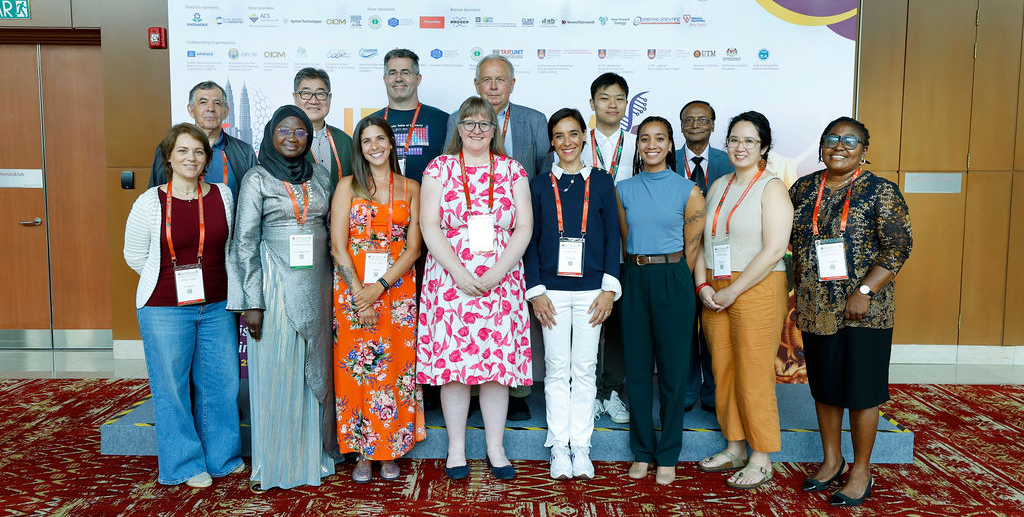
Members of the International Union of Pure and Applied Chemistry (IUPAC) Committee on Chemical Research Applied to World Needs (CHEMRAWN), Beyond Benign’s partner on the “Promoting Chemistry Applied to World Needs” webinar series.
Designing Chemistry for Global Challenges: Expert Perspectives
January 22, 2026
Learn from experts in the field who are leading the charge to solve world needs through chemistry. Chemistry doesn’t just shape technologies; it shapes outcomes. It influences who has access […]
Categories:
Empower Your Students With Safer, More Sustainable Science Labs: Enroll in a Beyond Benign Professional Development Course
 Beyond Benign’s summer professional development courses help teachers reinvigorate their lessons to better engage students and prepare them for future careers. Through the courses, middle school and high school teachers learn how to incorporate green chemistry into their classrooms, update labs to be safer and more sustainable, and inspire students to critically engage with environmental and sustainability challenges.
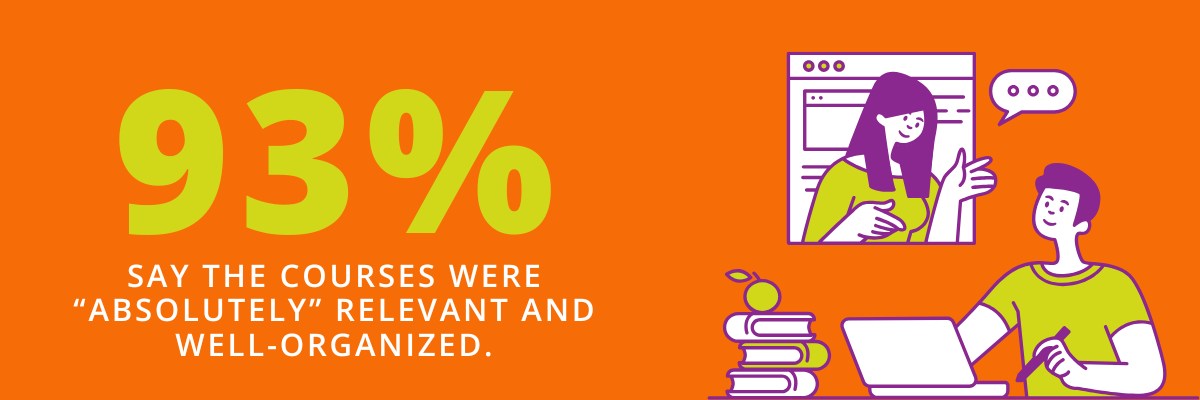
Past participants have high praise for the online courses, which are taught by Beyond Benign’s Certified Lead Teachers over 6 to 8 weeks. Teachers who took the courses in 2024 lauded their well-structured content, actionable resources, collaborative nature, and profound impact on teaching.
 Interested in transforming your classroom or lab for the better? Check out the teacher testimonials below, which reflect the value they found in learning from expert instructors and tapping into innovative classroom resources that incorporate the principles of green chemistry. Then, learn more about the 2026 Beyond Benign summer professional development courses and enroll by June 2, 2026.
 Teacher testimonials:
What participants say they’ll take back to the classroom:
- How to incorporate the principles of green chemistry and make small shifts that have a large impact.
- When household chemicals can be used to complete lab activities—a cost-effective and planet-friendly alternative.
- How to use the green chemistry principles to create compelling lessons.
 Teacher testimonial:
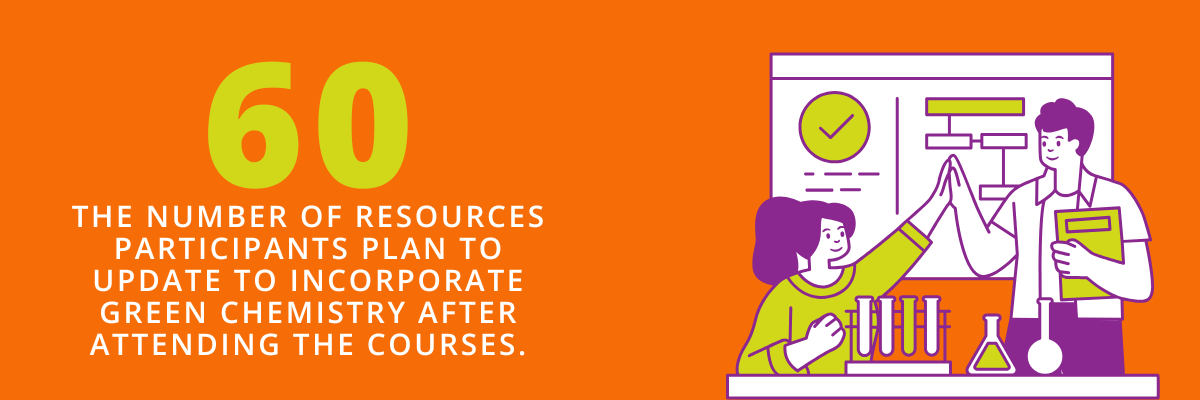
 What participants say the courses provide:
- I like that we were given freedom over our choices in terms of our lessons and projects. This allowed me to create work that I will use and that I’m proud to share with my department.
- I feel more knowledgeable about sustainability and innovation in industry with regard to green chemistry, as well as more confident and comfortable in implementing these ideas to my students in an engaging manner.
 Teacher testimonial:
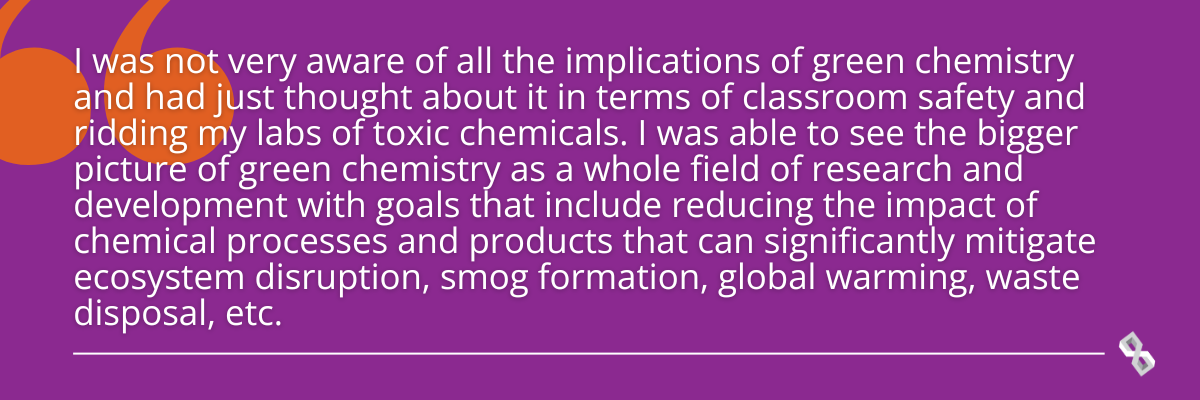 How participants plan to incorporate green chemistry in their classrooms:
- I plan to incorporate green chemistry principles into my lecture content, have green chemistry extensions in some of my current activities, and try out three to four replacement labs.
- I rewrote an entire unit on solutions in my curriculum and modified my intro unit.
- By using safer materials in our lab activities, by discussing using safe skin and makeup products that are cruelty-free, by reading about the green chemistry movement.
The Ultimate Impact: A Better Future for Students and the Planet
Participants said the course materials and learnings will have long-term benefits for their students as they encounter future sustainability challenges.
 Ready to transform your chemistry course with innovative labs and resources that help students shape a more sustainable future? Registration is open through June 2, 2026, for these courses:
- Sustainable Science: Contextualizing Chemistry Through Safer Hands-On Labs
- Introducing Green Chemistry in the High School Classroom
- Advanced Green Chemistry: Connections to Our World*
 *Teachers who want to take their Advanced Green Chemistry course a step further can apply for the Green Chemistry Fellowship. This four-month fellowship program includes mentorship from a Beyond Benign Certified Lead Teacher, peer support, shared learning, additional credits, and a classroom gift card.
How to get involved:
- Enroll in a Beyond Benign professional development course to discover the transformative power of green chemistry. Explore current offerings and register by June 2, 2026. Bonus: Thanks to generous support from our partners at the New York State Pollution Prevention Institute (NYP2I), we are able to offer these courses free of charge to teachers in New York. Contact us (info@beyondbenign) for more details.
- Get to know the incredible educators who teach the professional development courses: Annette Sebuyira, Cassidy Javner, and Erin Mayer.
- Subscribe to Green Sparks, a free six-part email series designed to make bringing sustainability into your classroom easier than ever.
- Are you a New York teacher in grades 6-12? Join the New York Green Chemistry Professional Learning Team to connect with peers and deepen your practice of green chemistry and sustainable science.

Empower Your Students With Safer, More Sustainable Science Labs: Enroll in a Beyond Benign Professional Development Course
January 22, 2026
Beyond Benign’s summer professional development courses help teachers reinvigorate their lessons to better engage students and prepare them for future careers. Through the courses, middle school and high school teachers […]
Categories:
Reflections from the Beyond Benign Team: The Power of Green Chemistry Education in 2025
 A look at the moments—from global gatherings to everyday connections—where our team felt the power and momentum of the green chemistry education community in 2025.
This year, we asked the Beyond Benign team to reflect on a simple question: Where did you feel the power of the green chemistry education community most strongly in 2025? Their responses span continents, classrooms, conferences, and conversations—each one offering a glimpse into the collective momentum shaping this movement.
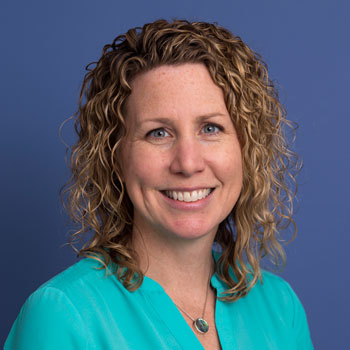
Dr. Amy Cannon
I have been fortunate to travel to several places this past year. I was truly moved by the dedication and passion I saw in places I visited across the globe. And, even though we are many miles away on opposite sides of the planet, we are all connected through the desire to make green chemistry an integral part of how we teach and practice chemistry.
In particular, I felt that sense of community during the Industrial Green Chemistry World conference in Mumbai, India, organized by the GreenChemistree Foundation. It was remarkable to hear about the research and advancements happening in India. We were able to visit two Universities (Somaiya University and St. Xavier College) while there, and the genuine passion of the faculty that I met was incredible.
Additionally, I had the opportunity to visit Chile last month, where the 2nd Green Chemistry Week and Symposium were organized at the Pontificia Universidad Católica de Chile. I was able to have lunch with a group of students from the University while there, and hearing their stories was heartwarming. A spark was lit inside them, and they would carry forward green chemistry into their future careers and various pathways.
Reflecting on these experiences, it is truly remarkable how far we have come as a global community. We are much more interconnected than we often realize. This global community is thriving and expanding rapidly, which gives me great hope.
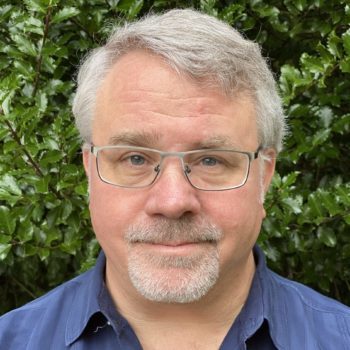
Dr. John Warner
I reviewed my activities for 2025, and I was a bit astounded by my personal activity inventory. In 2025, I gave 117 lectures (at 50 Universities, 45 conferences, and 22 companies)! 72 of these presentations were in person (20 different U.S. states and 17 different countries). I estimate that over 10,000 people listened to me this past year! While I am certainly feeling my age (kinda tired, kinda sore…), I can’t help but have an overwhelming sense of gratitude and feeling of how fortunate I am to be part of such an amazing movement and community.
Every time I speak, I can literally “feel” the magic of the look that emerges on some of the people’s faces. The impact is tangible as they not only start to understand what green chemistry is, but more importantly, begin to understand how they themselves fit into the bigger picture. Always, during every talk I give, my last slides are about the amazing people at Beyond Benign. Being an overly emotional Sicilian, more often than not, I break up a little, my eyes water, and my voice cracks as I show the pictures of the Beyond Benign team and the map of the Green Chemistry Commitment (GCC) signers.
After my talk, people come up to me. The things they say to me… sometimes they say nothing, they just look at me… and it is at that moment that I most strongly feel the power of the green chemistry education community.
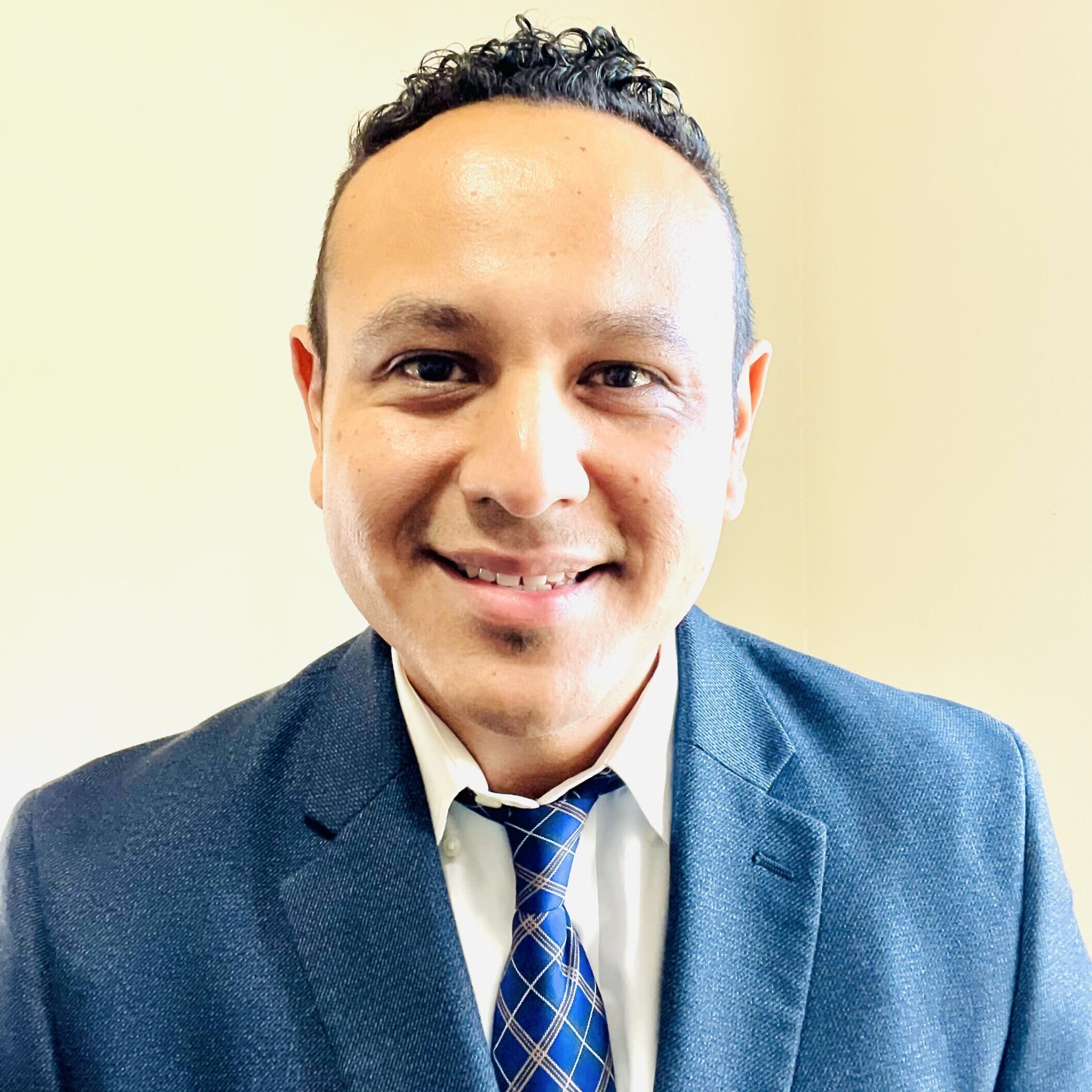
Dr. Omar Villanueva
In 2025, I felt the power of the green chemistry education community most vividly during moments when collaboration translated into real movement—primarily through the Green Chemistry Commitment (GCC) network and the work leading up to the GCC Virtual Summit. Watching educators, program leaders, our Beyond Benign team, and students show up not just to attend, but to contribute, share ideas, and push forward systemic change reminded me that this community is not passive—it is active, creative, and full of collective momentum. Hearing how institutions are embedding green chemistry into courses, labs, and student experiences made it clear that this work is no longer theoretical—it’s happening. It’s spreading because people care deeply.
I also saw how our impact is expanding globally, with growing interest and great promise internationally. Through conversations with faculty and students, I learned there is a strong and urgent need for Spanish-language resources in Latin America—a gap our community is eager to fill. This was especially evident during my Spanish-language webinar for South America, which brought together 453 attendees from 32 countries. The engagement was incredible—questions, resource sharing, and immediate plans to embed green chemistry into courses—and it made the global momentum of this movement feel tangible. You could feel the spark turning into action.
It reminded me that when we create space for connection, educators show up ready to lead change across borders and classrooms. I can’t wait to see what 2026 brings and how we continue to grow, connect, and transform chemistry together.

Dr. Jonathon W. Moir
Every December, as we approach the end of another calendar year, I often find it difficult to remember everything that Beyond Benign accomplished throughout the year. Hopefully it doesn’t have to do with getting older, but I think it’s likely because, as a team, we are always so focused on what we are working on at the moment that we rarely get this chance to think back and reflect on where we’ve been and how it made us feel.
For me, there are many instances where the power of our community and of the green chemistry education movement really shone through, but they take on different forms. Throughout 2025, I saw it every week online on the Green Chemistry Teaching and Learning Community (GCTLC) platform, with over 3,000 users from more than 100 countries now registered on the site and more joining every day. We see questions being asked in the GCTLC forums and genuinely caring and thoughtful responses from our moderators and other users. We see folks introducing themselves in GCTLC group spaces and sharing helpful resources and links with each other. And we see new resources being submitted to the platform each month (unprompted) by community members from all over the world interested in sharing their lab experiments or activities or lecture content, all focused on bringing green chemistry to students. These are the kinds of things that the GCTLC platform was designed for, and it’s always so rewarding to feel that we’ve helped others, with each small change and contribution adding up to greater systemic change in the long run.
In person, the energy was palpable when speaking with our Green Chemistry Commitment (GCC) signers, students, and community members at the Canadian Chemistry Conference and Exhibition (CSC 2025) this past summer. With a newly launched Green Division at the Chemical Institute of Canada, there was a lot of excitement and buzz, with Beyond Benign and the GCC program being mentioned and featured heavily during the conference. As the Canadian chemistry community pushes for the inclusion of green chemistry in postsecondary accreditation requirements to mirror those of the U.S., the momentum is palpable. Having co-organized both a workshop and symposium, I could clearly see the enthusiasm from students and faculty alike. So many opportunities to connect, so many ways to do more. I think it’s just a matter of time before we see a complete and total shift in how chemistry is taught across the world.

Dr. Juliana Vidal
For me, 2025 was a challenging year. With so much happening in the world and in my own personal life, there were moments when pushing for change in the status quo felt heavier than usual. However, every time I connected with the Green Chemistry Commitment (GCC) community, I felt my energy coming back. Seeing this community grow and thrive (we’ve had 50 new institutions join the program in 2025, which is now in more than 35 countries), feeling their enthusiasm in person and seeing their work in both virtual and in-person conferences brought back my own resilience.
The GCC Ambassador program and the Green Chemistry Connections webinar series remained my favorite initiatives, and I feel so privileged to collaborate with these incredible faculty members and students to keep promoting green chemistry and witness their impact around the world—one person’s green chemistry journey becoming another’s, and individual passion driving systemic transformation.

Dr. Monica Soma Hensley
Attending and seeing the engagement of the Green Chemistry Commitment (GCC) community during the in-person 2025 GCC Summit was a highlight for me this year. I also enjoyed collaborating with passionate faculty on the Case Study Template and the Soy Chemistry Curriculum projects.

Michelle Duarte
I felt the power of the green chemistry education community when I participated in the Green Chemistry Connections webinar. It was incredible to see people connecting, exchanging ideas and experiences, and uniting for a better future.
In addition, it is inspiring to see how institutions are committed to promoting and raising awareness within their community about the importance of green chemistry, through events and updating their curricula to introduce these concepts in classrooms and laboratories.
The highlight of my year was the opportunity to join the Beyond Benign team, where I will have the chance to contribute to further expanding the reach of green chemistry education and supporting the growth of this community.

Tyler Schisler
This year, I experienced the strength of the green chemistry Education community every day through my work on the Green Chemistry Teaching & Learning Community (GCTLC). From community members submitting new learning objects for educators to integrate into their curricula to like-minded individuals supporting one another in our forum spaces, the impact of our community was evident everywhere.
Dr. Sarah Kennedy
Every time I see a new learning object submitted to the Green Chemistry Teaching & Learning Community (GCTLC), I get excited about the power of this community! When our community comes together to share ideas for classes, lab experiments, and research, we are helping each other adopt and implement tangible ways that we can do chemistry better. It is the power of this community that will transform the new generation of scientists and put green chemistry at the forefront of all chemical endeavors. I am so lucky to be part of the amazing GCTLC and Beyond Benign teams!

Dr. Alisha Szozda
This year, I felt the power of the green chemistry education community most strongly when attending the green chemistry symposium talks and presenting a workshop on getting green chemistry into your research at the Canadian Society of Chemistry Conference this summer! It is incredible to see all the amazing work that is being done in the community. I also got to meet so many cool people when attending the ACS GCI Green Chemistry Summer School this summer! It was so motivating and inspiring to meet a group of young researchers and educators so passionate about green chemistry!
How You Can Get Involved:
- Stay connected with green chemistry education: Subscribe to the Beyond Benign newsletter to receive periodic updates with green chemistry news, educator stories, helpful resources, and upcoming events tailored to your interests.
- Join the Green Chemistry Teaching and Learning Community (GCTLC): Connect with thousands of educators, students, and professionals working to transform chemistry education. The GCTLC offers networking, mentorship, resource sharing, and a supportive space grounded in shared values and a vision for systemic change.
- Learn how your institution can get involved in the Green Chemistry Commitment (GCC): The GCC provides a flexible framework to help higher education institutions integrate green chemistry into teaching and research while connecting to a global community of peers. Discover why more than 100 institutions have joined—and how yours can too.
Reflections from the Beyond Benign Team: The Power of Green Chemistry Education in 2025
December 15, 2025
A look at the moments—from global gatherings to everyday connections—where our team felt the power and momentum of the green chemistry education community in 2025. This year, we asked the […]
Categories:
- 1
- 2
- 3
- …
- 20
- Next Page »


