





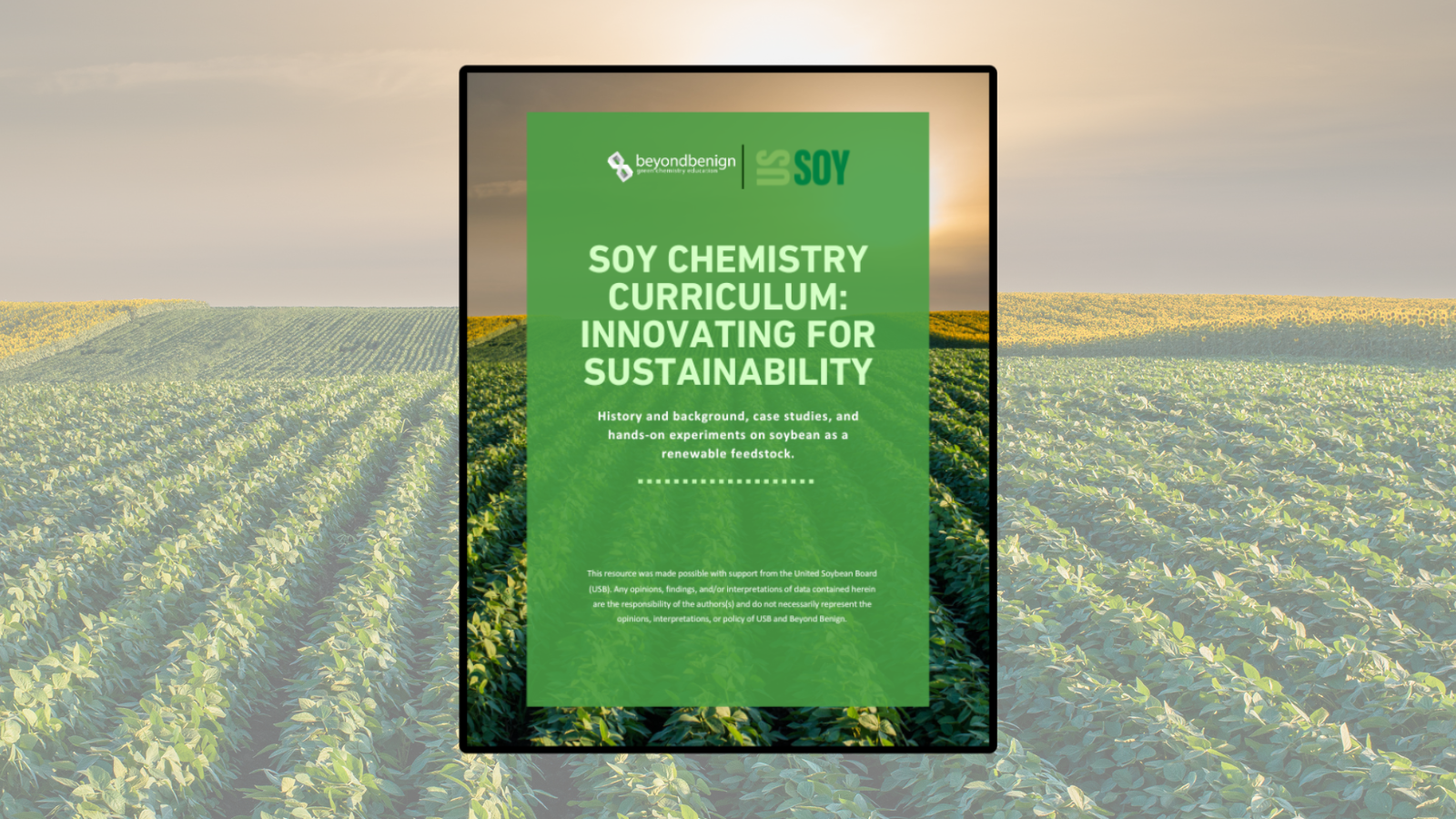
 Today’s students want their science to matter. They want to see the role chemistry (and green chemistry) can play in addressing sustainability challenges such as climate change, rural economies, and protecting human and environmental health. The new Soy Chemistry Curriculum, created by Beyond Benign in collaboration with educators and industry experts from Omni Tech International and supported by the United Soybean Board (USB), gives them that opportunity.
This three-module undergraduate curriculum uses soy—one of the world’s most abundant renewable crops—as a lens for teaching green chemistry and sustainability. Through lecture content, industry case studies, and lab experiments, it connects core chemistry concepts to material innovation in a way that feels real and relevant.
As Kris Weigal of Omni Tech International explains, “Soy chemistry offers a tangible example of how renewable resources can be used to create safer, more sustainable products. It’s a gateway for students to understand the broader field of bio-based chemistry, which is essential as we transition away from petroleum-derived materials.”
Connecting Agriculture and Chemistry
Renewable feedstocks are reshaping what’s possible in both research and the classroom. Soy, in particular, offers a powerful entry point: it’s abundant, versatile, and deeply tied to real economies and communities.
For the educators who helped build the Soy Chemistry Curriculum, that connection is more than academic. Curriculum co-author Jane Wissinger’s perspective is shaped by both science and agriculture. Her family’s farmland in South Dakota keeps her close to the realities of planting, harvesting, and markets, while her early work as a crop herbicide chemist deepened her understanding of the chemistry that supports farmers and renewable crops like soy. Michael Wentzel grew up in rural Iowa and sees soy as a way to connect chemistry to everyday life and regional industries. During his postdoctoral work in Kansas, Julian Silverman saw how farmers themselves were eager to collaborate on new innovations using soy-based materials.
Their combined insight illustrates how soy serves as an effective context-based teaching tool. It links chemistry to real materials and real people, showing students the connection between agricultural resources, product development, and sustainable design. In the classroom, soybeans become more than a feedstock—they become a window into renewable materials science and systems thinking.
Inside the Soy Chemistry Curriculum
The Soy Chemistry Curriculum offers a flexible way for undergraduate instructors to integrate green chemistry into both lecture and laboratory settings. Its three modules can be used as a full sequence or adapted individually.
- Module I introduces soy as a renewable feedstock, exploring its history and background as well as how the molecular structure of extracted soybean oil and soybean meal influences their properties and applications.
- Module II uses industry case studies to show how soy-based chemistry is replacing petroleum-derived materials in adhesives, surfactants, coatings, and other products. It also introduces Life Cycle Assessment (LCA) and Techno-Economic Analysis (TEA) to help students evaluate environmental and economic tradeoffs.
- Module III brings concepts to life in the lab. Students convert soybean oil into functional materials using greener synthesis methods, applying the Twelve Principles of Green Chemistry while analyzing performance and safety.
For Dr. Jane Wissinger, the curriculum’s power lies in its relevance. “There is an abundance of interesting content related to the chemistry of soybean components and a wide variety of applications familiar to students in everyday life,” she said. “By moving from foundational chemistry to real industrial case studies, the curriculum shows how renewable, potentially biodegradable, and nontoxic materials can replace fossil fuel–based chemicals that are depleting, non-degradable, and often toxic.”
A Collaboration Between Academia and Industry
Developed through a partnership between educators in Beyond Benign’s Green Chemistry Commitment (GCC) program and industry professionals at Omni Tech International, the Soy Chemistry Curriculum was designed to prepare students for applied chemistry careers.
Kris Weigal of Omni Tech International said the collaboration ensured that students can see how chemistry translates beyond the classroom. “My role involved distilling complex real-world industrial processes and product development pathways into accessible, engaging educational content,” she said. “By presenting industry challenges and innovations in a relatable way, we aimed to spark curiosity and critical thinking among students.”
For Dr. Julian Silverman, collaboration also expands what chemistry can mean across disciplines. “Working at a fashion school, my students are interested in using sustainable materials to tackle issues like fast fashion,” he said. “By collaborating with experts across the green chemistry community, I can bring scientific innovation to a broader audience — the artists and designers who make our clothes, cosmetics, and more.”
He also sees value in how the curriculum introduces students to real-world decision-making. “In addition to formulating new materials, it’s important to evaluate their commercial feasibility,” he said. “Using green chemistry metrics with economic metrics is a powerful way to show students that sustainability has to work in both science and the real world.”
Together, these perspectives ground the curriculum in applied learning, showing students how chemistry drives innovation in agriculture, product design, manufacturing, and sustainable materials development.
Advancing Green Chemistry Education
The Soy Chemistry Curriculum is part of a wider effort to transform chemistry education. Each module is grounded in the Twelve Principles of Green Chemistry, giving educators practical tools to teach safer chemical design, waste minimization, and responsible material selection. The curriculum also aligns with the United Nations Sustainable Development Goals (UN SDGs).
For Amy Cannon, Executive Director and Co-Founder of Beyond Benign, this kind of resource reflects a growing shift in science education. “This curriculum gives educators a way to connect core scientific concepts with real-world decision-making around sustainability,” she said. “When students learn to design chemistry with health, safety, and environmental impact in mind, they are better equipped to lead in any field of science.”
By publishing the curriculum on the Green Chemistry Teaching and Learning Community (GCTLC) platform, Beyond Benign ensures that it is freely available to educators worldwide. Instructors can access ready-to-use teaching materials, assessments, and instructor notes, while those seeking deeper engagement can participate in the Green Chemistry Commitment (GCC) program for professional development and peer collaboration.
Looking Ahead
The Soy Chemistry Curriculum is more than a teaching resource—it expands what chemistry education can do. By grounding learning in real materials, real industries, and real environmental challenges, it gives students the tools to think critically and design more sustainable solutions.
As Dr. Michael Wentzel reflected, “I hope folks realize that chemists are creative and able to use different resources for the applications required. The ability to modify soybean oil, especially, provides enormous potential.” That potential now lives in classrooms and labs, shaping the next generation of scientists.
The full Soy Chemistry Curriculum is freely available on the Green Chemistry Teaching and Learning Community (GCTLC) platform, along with teaching tools and educator support from Beyond Benign.


