





Green Chemistry Education in the News:
Select a Category
Incorporating Green Chemistry Principles into Chemistry Fundamentals Education at UC Santa Barbara
An interview with Morgan Gainer
In 2013, Beyond Benign created the Green Chemistry Commitment (GCC) program with guidance from higher education
institutions as a framework to unite the global Green Chemistry community. The GCC goal is to infuse Green Chemistry into Higher Education and give scientists the required skills to design processes and products less hazardous to human health and the environment.
Beyond Benign has partnered with companies including Dow, MilliporeSigma, and Biogen to further its mission to empower educators to transform chemistry education for a sustainable future. Support from these partners has allowed Beyond Benign to create resources, foster relationships, and provide essential funding to educators, all in an effort to grow and strengthen the Green Chemistry education community.
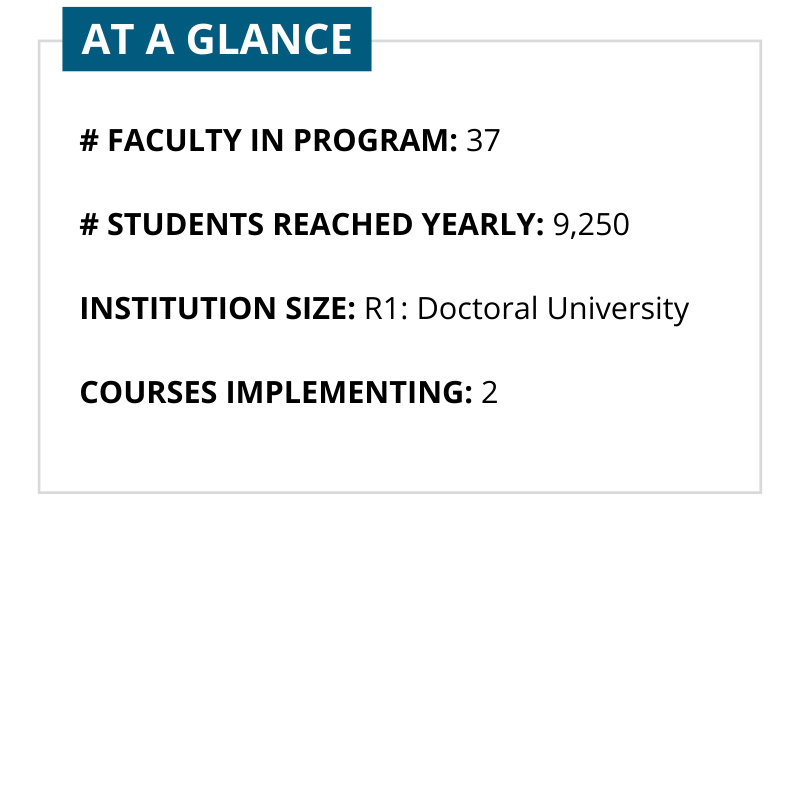
UC Santa Barbara is a Dow academic partner and GCC signer. Discover the university’s story in our interview with Chemistry Lecturer Morgan Gainer.
How has being part of the GCC impacted your institution and you as a faculty member?
I am the director for the undergraduate organic chemistry laboratories at UCSB and have appreciated the many resources that the GCC has available to facilitate the implementation of green chemistry principles and practices. We have implemented green chemistry practices into many of our organic chemistry experiments, allowing us to highlight green chemistry at the same time that students are learning about fundamental organic chemistry reactions and techniques. This implementation has resulted in reduced waste generation, improved performances in the students’ experiments, and a greater understanding for our students of the importance of green chemistry.
What student outcomes have you observed since instituting green chemistry practices and principles?
We have observed that students are gaining a great appreciation for, and understanding of, green chemistry principles. We have been able to incorporate many green principles into our educational labs. As part of this incorporation, we have them evaluate an experiment to determine in what ways the experiment does or does not meet the principles of green chemistry. The students have responded positively to this experience, and it is clear that they understand the value of green chemistry, both for themselves personally and for society as a whole.
How do you envision the GCC community supporting the future green chemistry goals of your institution and training of your students?
We will continue to design and implement educational experiences for our students that incorporate green chemistry principles. I believe the GCC community overall has a passion for both green chemistry and education, and that the GCC can play an important role as educators support one another in their efforts to train up the next generation of chemists and scientists.
Incorporating Green Chemistry Principles into Chemistry Fundamentals Education at UC Santa Barbara
October 15, 2023
An interview with Morgan Gainer In 2013, Beyond Benign created the Green Chemistry Commitment (GCC) program with guidance from higher education institutions as a framework to unite the global Green […]
Categories:
A Growing Community of Green Chemists at Southern University
An interview with Conrad Jones
In 2013, Beyond Benign created the Green Chemistry Commitment (GCC) program with guidance from higher education institutions as a framework to unite the global green chemistry community. The GCC goal is to infuse green chemistry into Higher Education and give scientists the required skills to design processes and products less hazardous to human health and the environment.
Beyond Benign has partnered with companies including Dow, MilliporeSigma, and Biogen to further its mission to empower educators to transform chemistry education for a sustainable future. Support from these partners has allowed Beyond Benign to create resources, foster relationships, and provide essential funding to educators, all in an effort to grow and strengthen the green chemistry education community.
Southern University is a Dow grant winner and GCC signer. Discover the university’s story in our interview with Assistant Professor of Chemistry Conrad Jones.
How has being part of the GCC impacted your institution and you as a faculty member?
The impact that GCC has on our chemistry department at Southern University has been tremendous. STEM students enrolled in our General Chemistry courses are introduced to green chemistry concepts in both lecture and lab courses. During this 2022-2023 academic year, green chemistry concepts have been incorporated in General Chemistry, Analytical Chemistry, and Organic Chemistry courses.
As a faculty member, I am very thrilled and appreciative of being part of the GCC in helping students and faculty in the chemistry department as well as other departments at Southern University. In addition, it has given me the opportunity to provide students with the knowledge and skills to learn and apply green chemistry concepts to chemistry to prepare them for the workforce in the area of green chemistry.
What student outcomes have you observed since instituting green chemistry practices and principles?
Since the start of implementing green chemistry concepts and practices into the chemistry curriculum at Southern University, we have noticed that many students have developed a strong interest in knowing more about green chemistry and inquire about being involved in green chemistry projects in the chemistry department at Southern University. Each semester since being awarded the grant, a faculty member in our department has given a Zoom presentation about green chemistry and its applications in a given area of chemistry. During these presentations, we present students with questions before, during, and after the presentations in regard to their knowledge of green chemistry. Even though many students had heard about green chemistry before the talk, few students had a real sense of what green chemistry is and its role in our society. However, during and after the presentations, many of those students were able to define and know what green chemistry is and its significance to society and the environment.
How do you envision the GCC community supporting the future green chemistry goals of your institution and training of your students?
I envision that the GCC community will continue to greatly support our green chemistry goals and training of our students at Southern University. However, I also want our chemistry department and our university to aid the GCC community’s mission and objective to talk about green chemistry and be very active with GCC and the community. With GCC’s continuing support of Southern University and its students, our students can become effective contributors in showing others how to use green chemistry to enhance the quality of life and the environment. I am very appreciative and thankful for the opportunity that Beyond Benign and Dow Chemical has given to my fellow co-PIs on this grant (Dr. Wendy Wang and Dr. Maryam Jahan), the Southern University Chemistry Department, and Southern University for being part of the GCC community.

A Growing Community of Green Chemists at Southern University
October 15, 2023
An interview with Conrad Jones In 2013, Beyond Benign created the Green Chemistry Commitment (GCC) program with guidance from higher education institutions as a framework to unite the global green chemistry […]
Categories:
‘Go Green!’: Green Chemistry Flourishes at Michigan State University
An interview with Rob Maleczka and James E. “Ned” Jackson
In 2013, Beyond Benign created the Green Chemistry Commitment (GCC) program with guidance from higher educatio
ninstitutions as a framework to unite the global green chemistry community. The GCC goal is to infuse green chemistry into Higher Education and give scientists the required skills to design processes and products less hazardous to human health and the environment.
Beyond Benign has partnered with companies including Dow, MilliporeSigma, and Biogen to further its mission to empower educators to transform chemistry education for a sustainable future. Support from these partners has allowed Beyond Benign to create resources, foster relationships, and provide essential funding to educators, all in an effort to grow and strengthen the Green Chemistry education community.
Michigan State University (MSU) is a Dow grant winner and GCC signer. Discover the university’s story in our interview with Professor Rob Maleczka and Professor James E. “Ned” Jackson.
How has being part of the GCC impacted your institution and you as a faculty member?
Rob: At Michigan State, green chemistry has long been part of the conversation. (After all, “Go Green” is part of the MSU lexicon!) For example, minimizing waste was among the drivers that led us to move to microscale labs decades ago. But making the Green Chemistry Commitment brought a sharper focus to those conversations, and teaching green chemistry became a more concrete goal. This is perhaps best illustrated by changes in our large enrollment organic sequence to labs that are not only inquiry-based but also built around Principles of Green Chemistry. We also now include a module on green chemistry in our course on chemical safety. And I think signing the GCC has provided added value to Professor Ned Jackson’s long running freshman seminar course on Green Chemistry. For me personally, being part of the GCC has motivated me not so much to change the specific body of chemistry that I’m teaching, but to change aspects of how I present that same chemistry.
Ned: Most of my own Green Chemistry activities are local. For instance, in my majors’ organic lectures, I describe and broadly illustrate the 12 Principles of Green Chemistry, including a special session on GC research at MSU. In my freshmen Green Chemistry seminar, besides the 12 Principles, we draw on environmental and historical stories of chemical syntheses (Hock cumene-phenol process), disasters (tetraethyllead in gasoline; global warming), triumphs (freons for refrigeration…) and unintended consequences (…but then ozone layer problems), showing how deep chemical understanding is needed to address many of the worlds largest problems. My own lab’s research has long had a focus on development of paths to make organic products and fuels from non-fossil sources. It is useful to know that the GCC offers resources and insights that I can access to enrich the work, both teaching and research. As an institution, and in collaboration with our chemical education colleagues, MSU has fully redesigned and updated our large non-majors organic lab experiences to include experiments that illustrate GC principles and metrics.
What student outcomes have you observed since instituting green chemistry practices and principles?
Rob: Students who are interested in joining my lab as undergraduate researchers are most definitely motivated by the prospect of making chemistry greener and more environmentally friendly. Perhaps just as significantly, they often bring with them pertinent green chemistry knowledge (e.g. which solvents are green and which aren’t). With the transformation of our lab courses, we now see students drawing conclusions made through the lens of the 12 Principles of Green Chemistry. Of course, what I’d like to think is that we’ve built the principles into their broader views on the environment and sustainability, as well as society and the economy. To be honest, I don’t know if we have achieved these larger outcomes. But this question has got me thinking that we should try to find out!
Ned: Students show gains in awareness and desire to connect chemistry to broader interests in environmental science, sustainability, critical evaluation of news and advertising, etc. Overall, their appreciation of chemistry as much more than an academic subject is expanded. Also growing is student interest in participating in research projects aimed at “greening” the world’s major chemical processes—energy, plastics, pharmaceuticals, recycling, etc.
How do you envision the GCC community supporting the future green chemistry goals of your institution and training of your students?
Rob: Maybe the GCC community can help with the last part of my answer to question 2! I see the GCC community as a catalyst that leads us to further refresh and renew Chemistry’s curriculum. As we do so, Beyond Benign’s resource gathering and sharing is sure to be helpful. Ideally, I’d also like to envision the GCC community becoming even more integrated in graduate education and training. In this regard, bringing more industrial partners into the community to better chart the role green chemistry can play in the professional development of our students would be terrific. Lastly, it would be a violation of some sort of faculty code if I didn’t say: it would also be terrific if to help support green chemistry goals, the GCC community were to work together on finding new ways to shake loose the needed funding from our respective administrations!
Ned: Though there is much material we draw on even within the academic ecosystem of MSU, I think we need to more thoroughly survey the offerings and exploit the stories and expertise accessible via our connection to the GCC. It is inspiring to have a clearinghouse for the creativity others have brought to both teaching and research efforts, illustrating both the significant needs, and the dynamism and versatility of tools, ideas, and new options that chemistry still offers.
‘Go Green!’: Green Chemistry Flourishes at Michigan State University
October 15, 2023
An interview with Rob Maleczka and James E. “Ned” Jackson In 2013, Beyond Benign created the Green Chemistry Commitment (GCC) program with guidance from higher educatio ninstitutions as a framework […]
Categories:
Growing Community, Connections and Inspiration at Prairie View A&M University
An interview with Andrea Oseolorun

In 2013, Beyond Benign created the Green Chemistry Commitment (GCC) program with guidance from higher education institutions as a framework to unite the global Green Chemistry community. The GCC goal is to infuse Green Chemistry into Higher Education and give scientists the required skills to design processes and products less hazardous to human health and the environment.
Beyond Benign has partnered with companies including Dow, MilliporeSigma, and Biogen to further its mission to empower educators to transform chemistry education for a sustainable future. Support from these partners has allowed Beyond Benign to create resources, foster relationships, and provide essential funding to educators, all in an effort to grow and strengthen the Green Chemistry education community.
Prairie View A&M University is a Dow academic partner and GCC signer. Discover the university’s story in our interview with Dr. Andrea Oseolorun.
How has being part of the GCC impacted your institution and you as a faculty member?
Signing on to the GCC has opened so many doors for our department, including new collaborations, new research directions, increased interest in more green and sustainable chemistry projects and proposals, more publications targeting green chemistry journals, and a new green chemistry course based on resources provided by Beyond Benign and other partners.
As a scientist from an interdisciplinary background in a department filled with Ph.D. chemists, [the GCC] has given me a voice and a way to show what I can offer to the academy. It has also allowed me to introduce my students to a subject that is of particular interest to me coming from an environmental science background.
What student outcomes have you observed since instituting Green Chemistry practices and principles?
I’ve always envisioned creating an environmental chemistry course in my department, and the encouragement I’ve received from the GCC community has built my confidence to move forward with the project. I have found my feet and my voice, literally, and I am looking forward to bigger things because of the assistance from my colleagues in the GCC. I have experienced a genuine sense of belonging as a scientist that was not there before.
It’s also helped me connect with new colleagues and students across the globe. I’ve met students in Berlin who are doing great work to advance green chemistry in the University. I have talked with colleagues in Canada and multiple states across the U.S., and I hope to work on research projects in the future.
How do you envision the GCC community supporting the future green chemistry goals of your institution and training of your students?
We hope to always have a forum to share our ideas and also learn from the community. We would like to see more outreach to support our efforts to increase awareness of the benefits of this new, more sustainable enterprise and how vital green chemistry education is to student success.

Growing Community, Connections and Inspiration at Prairie View A&M University
October 15, 2023
An interview with Andrea Oseolorun In 2013, Beyond Benign created the Green Chemistry Commitment (GCC) program with guidance from higher education institutions as a framework to unite the global Green […]
Categories:
Green Chemistry Research Interest Grows at the University of Minnesota
An interview with Jane Wissinger
 In 2013, Beyond Benign created the Green Chemistry Commitment (GCC) program with guidance from higher education institutions as a framework to unite the global Green Chemistry community. The GCC goal is to infuse Green Chemistry into Higher Education and give scientists the required skills to design processes and products less hazardous to human health and the environment.
Beyond Benign has partnered with companies including Dow, MilliporeSigma, and Biogen to further its mission to empower educators to transform chemistry education for a sustainable future. Support from these partners has allowed Beyond Benign to create resources, foster relationships, and provide essential funding to educators, all in an effort to grow and strengthen the Green Chemistry education community.
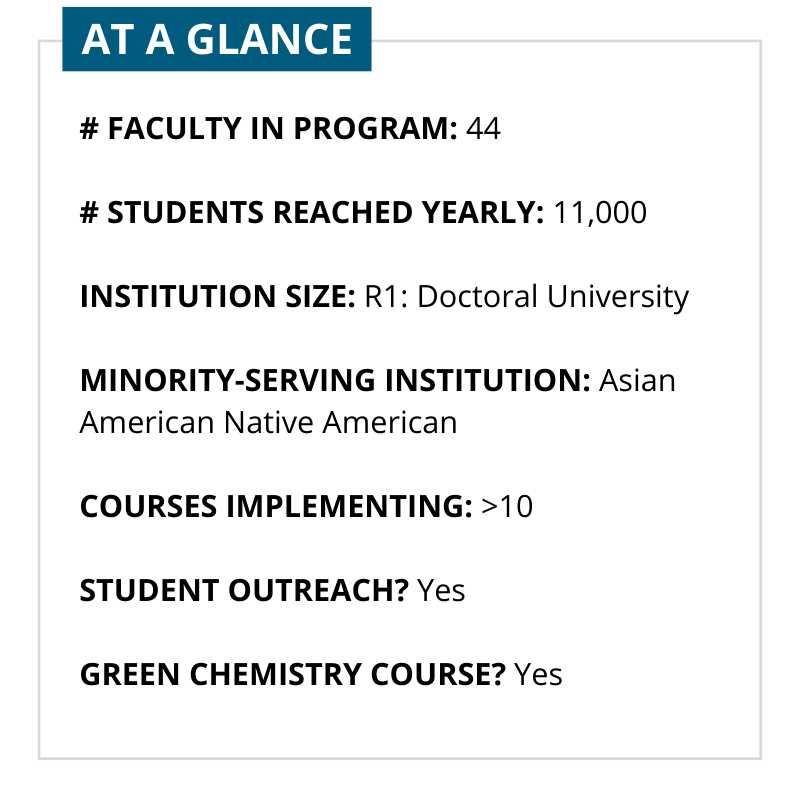
The University of Minnesota (UMN) is a Dow academic partner and founding GCC signer. Discover the university’s story in our interview with Morse-Alumni Distinguished Teaching Professor, Jane Wissinger.
How has being part of the GCC impacted your institution and you as a faculty member?
Since signing the GCC in 2013, many new and diverse initiatives evolved through the support and resources provided through this program. Green chemistry was already incorporated in the organic laboratory course, but the GCC sparked interest in developing a dedicated green chemistry upper-division lecture course. This course has been taught by five different faculty instructors, each with their own influences and research connections, expanding the breadth and diversity in green chemistry and engineering concepts for our students.
Being part of the GCC encouraged the addition of toxicology into the course and fostered collaborations with departments such as the MN School of Public Health as well as state agencies such as the Minnesota Pollution Control Agency. Personally, these interactions opened opportunities of learning and examples of new curriculum content to continue improving upon my own courses as well as disseminating ideas to other instructors for their courses.
What student outcomes have you observed since instituting Green Chemistry practices and principles?
Student outcomes are evident at both the undergraduate and graduate student levels. At the undergraduate level, students who were introduced to green chemistry were increasingly interested in research opportunities where they could apply the principles. In the last three years, the ACS MN student chapter made a concerted effort to increase green chemistry programming and won a Green Chemistry Chapter award in 2022.
At the graduate student level, two major efforts have emerged. One involves our department’s Joint Safety Team (JST) that promotes reducing risk through substitution or elimination of the hazards when possible and provides resources through their website. Second, is a new committee called the Sustainable and Green Chemistry committee that is comprised of graduate students, staff, postdocs, undergraduates, and faculty all working together to build a culture of sustainability and green chemistry in the department. The graduate students, in particular, are working to improve sustainability practices in the research laboratories.
How do you envision the GCC community supporting the future green chemistry goals of your institution and training of your students?
I believe it is important that students at all levels see evidence that their academic training will be relevant to their future careers, and that their careers will have an impact on society. This applies to both academic and industrial positions. The fact that companies such as DOW are backing this initiative is of HUGE consequence and illustrative of the fact that green and sustainable chemistry is increasingly valued by the entire chemical enterprise; not just educators.
I envision the GCC continuing to provide a strong community of educators with resources and opportunities to build bridges between student training and industrial partners. This will enable chemistry students to see themselves in a career that can have a profound impact for the future.
Green Chemistry Research Interest Grows at the University of Minnesota
October 15, 2023
An interview with Jane Wissinger In 2013, Beyond Benign created the Green Chemistry Commitment (GCC) program with guidance from higher education institutions as a framework to unite the global Green […]
Categories:
Dow Green Chemistry Education Challenge Award Winners Catalyze Green Chemistry at Higher Education Institutions
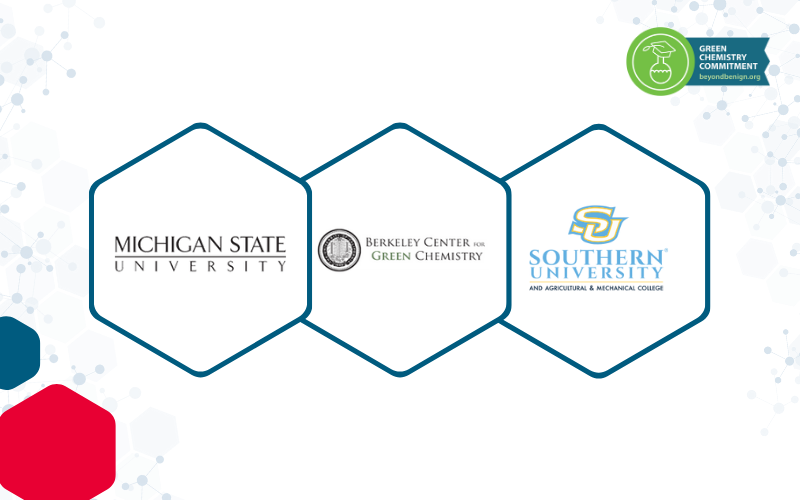 Amidst a pandemic that challenged educators and the education system, Beyond Benign and Dow successfully designed and launched the first Green Chemistry Education Challenge Awards to advance green chemistry at Dow’s partners institutions. Five institutions applied, and three universities were awarded a combined total of $30,000 for their year or multi-year projects. Through the awards, the three institutions will design approximately 10 teaching resources for undergraduate courses, which will help bring green chemistry directly to 3,000+ students each year.
Michigan State University
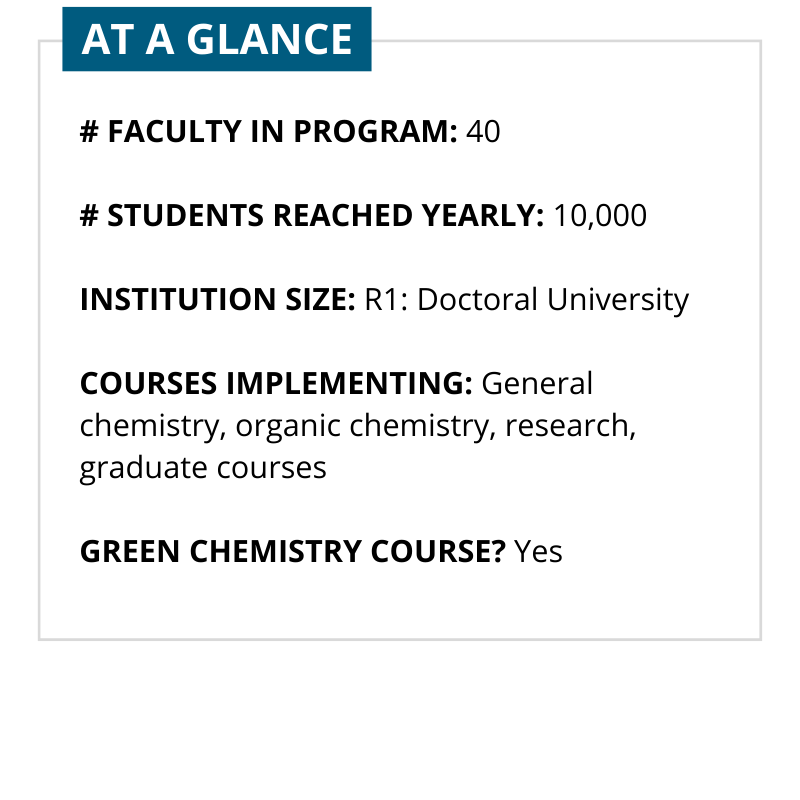
Michigan State University (MSU) is a research university in East Lansing, Michigan (USA) founded in 1855. With 40 faculty members, its interdisciplinary Chemistry department can reach about 10,000 students yearly. MSU has joined Beyond Benign’s Green Chemistry Commitment program in 2018 with the goals of integrating green chemistry throughout its departmental research, teaching, and service. The implementation of green chemistry in MSU is currently not only performed in faculty and student research, but in its organic and green chemistry courses, as well as in its Research Experience for Undergraduates (REU) program and safety course.
MSU has undertaken a project to transition its large-enrollment undergraduate organic chemistry laboratory course to a Green Chemistry Project-Based laboratory. Under faculty supervision, a small group of undergraduate students have been beta testing this project which aims to cultivate students’ analytical thinking, effective citizenship, effective communication, and integrated reasoning abilities. With the funding obtained through Dow and Beyond Benign’s first Green Chemistry Education Challenge Award grant, MSU was enabled to plan and carry out the Green Chemistry Project-Based laboratory course investigation and evaluation while supporting the beta-testing undergraduate students. The implementation of MSU’s new laboratory will be able to reach approximately 1,300 students who take the Green Chemistry Project-Based laboratory course each year. Upon the completion of its study, MSU plans to publish its findings online with free access and share them at upcoming conferences so these resources can be adopted, incorporated, and practiced within the global green chemistry community and beyond.
University of California, Berkeley
With over 65 faculty members, the Berkeley Center for Green Chemistry (BCGC) at the University of California (UC) Berkeley (USA) has been a Green Chemistry Commitment Signer since 2013. Their Chemistry program is able to reach more than 16,000 students annually and it is currently advancing green chemistry through research, teaching, and engagement in interdisciplinary areas. The goal is to place green chemistry, alongside carbon-neutral technologies, as a cornerstone of environmentally sustainable development and the green economy.
At UC Berkeley, faculty members, instructors, and graduate students have adjusted a published green chemistry experiment to fit the needs and resources of an introductory organic chemistry lab class (CHEM 3AL) attended by approximately 600 non-majors. In the initial experiment entitled ‘Student-Designed Green Chemistry Experiment for a Large-Enrollment, Introductory Organic Laboratory Course’ by Wu et al., students performed a “standard” procedure and then adjusted a variable of their choice to make it greener. UC Berkeley students tested the initial experiment, which then allowed faculty and instructors to pinpoint areas in which it required improvement for its incorporation into the CHEM 3AL course.
The Green Chemistry Education Challenge Award offered by Beyond Benign and Dow allowed UC Berkeley to support and compensate the two graduate students involved in this project. Besides the creation of a slide deck with the material developed, a survey to analyze students’ attitude towards green chemistry’s relevance was designed. The materials created along with the project will be implemented in the Spring 2023 semester and will be made available to other institutions.
Southern University and Agricultural & Mechanical College
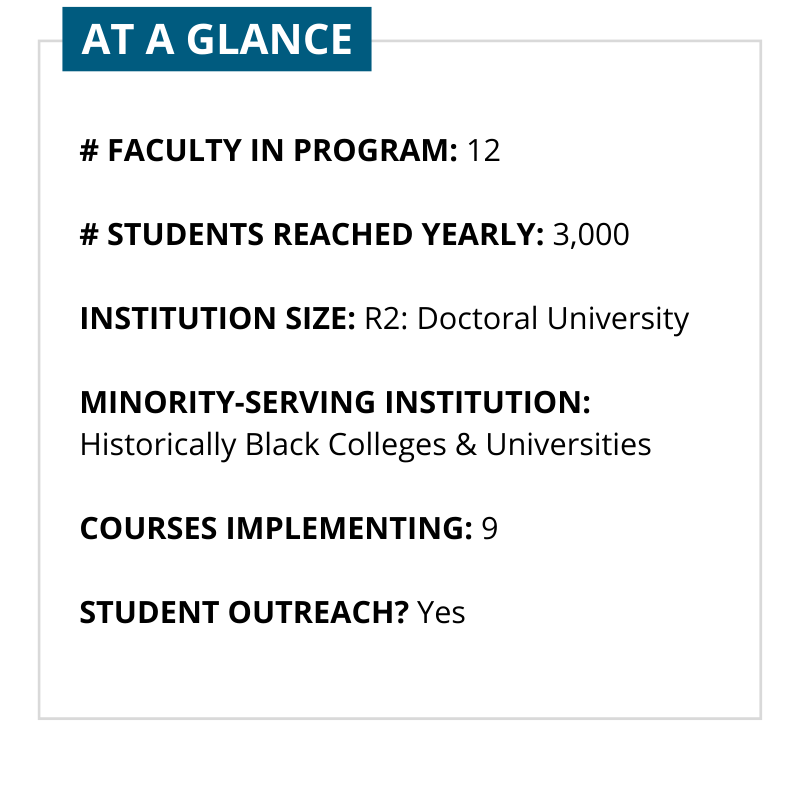
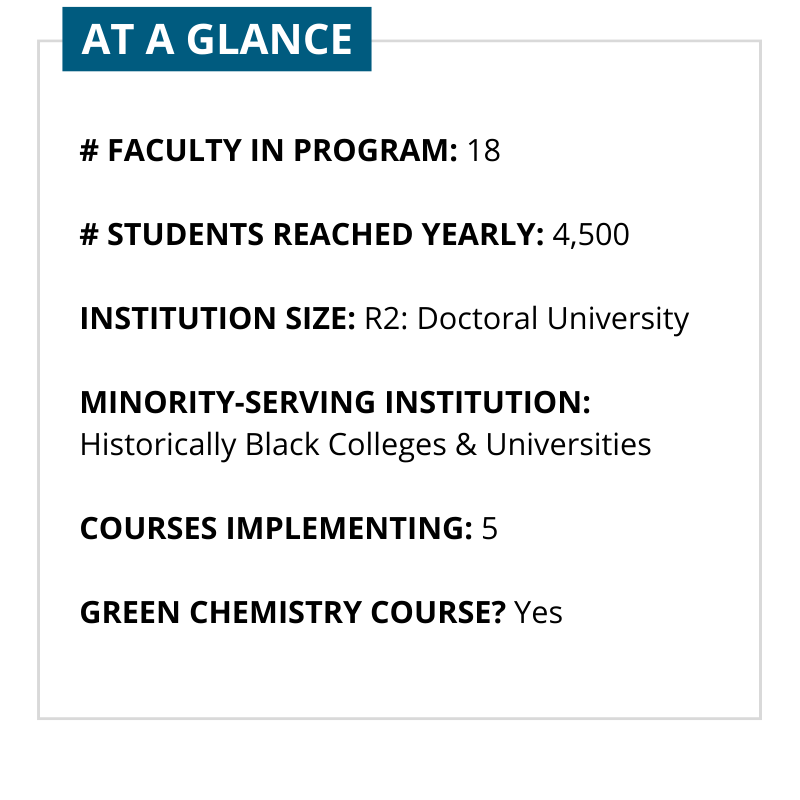
As a Green Chemistry Commitment Signer since 2021, Southern University and Agricultural & Mechanical (A&M) College is a Historically Black College & University (HBCU) in Baton Rouge, Louisiana (USA). This institution has the goal to increase the implementation of green chemistry practices in its biochemistry, general, organic, inorganic, analytical, environmental, and physical chemistry courses, while also continuing to foster inclusion and belonging for populations underrepresented in STEM areas. At Southern University, more than 3,000 students are learning concepts and obtaining hands-on experience in the application and importance of green chemistry in creating more benign materials to human health and the environment.
The Green Chemistry Education Challenge Award grant offered by Beyond Benign and Dow has allowed Southern University and A&M College to be able to continue the path of implementing green chemistry in its courses. Since the beginning of this journey, many students and faculty members have gained much more interest in the area. The work developed by Southern University A&M College is an inspiration for the incorporation of green chemistry into the curriculum of universities that mainly serve underrepresented individuals, and would therefore enhance the curriculum at those institutions to better prepare their students for their future careers. Moreover, the funding received has allowed Southern University and A&M College to use results, ideas, and other findings from this project as preliminary data to obtain future funding in green chemistry, which will continue to help Southern foster relationships with other institutions as well as its local community and K-12 schools.
Dow Green Chemistry Education Challenge Award Winners Catalyze Green Chemistry at Higher Education Institutions
October 15, 2023
Amidst a pandemic that challenged educators and the education system, Beyond Benign and Dow successfully designed and launched the first Green Chemistry Education Challenge Awards to advance green chemistry at […]
Categories:
Announcing the Launch of the Green Chemistry Teaching and Learning Community (GCTLC)
Wilmington, MA: Beyond Benign, in partnership with sponsors and partners including the American Chemical Society Green Chemistry Institute (ACS GCI), is excited to announce the launch of the Green Chemistry Teaching and Learning Community (GCTLC): an online hub for everyone in the green chemistry community to share, connect, learn, and grow together.
Developed in collaboration with green chemistry leaders and educators worldwide, the GCTLC is a dynamic virtual space where community members can develop connections, find mentors, share resources, and enhance their knowledge through peer-led learning.
“We created the GCTLC alongside passionate educators, industry partners and stakeholders within the green chemistry education community to ensure it truly serves everybody,” said Dr. Jonathon Moir, GCTLC Senior Program Manager. “Because we cultivated this platform together, the GCTLC exists as a teaching and learning platform and also a living testament to the unity and collaboration underpinning our community.”
Designed with K-12 educators, higher-ed faculty, and student leaders in mind, the GCTLC serves as a central meeting space for green chemistry enthusiasts to connect in real time.
“The GCTLC fills a big gap, particularly in the education space,” said Dr. Glenn Hurst, Professor at University of York and GCTLC Leadership Committee Member. “The challenge to transform our community and make a real difference in the widespread integration of green chemistry into education is one the GCTLC is perfectly placed to address.”
The GCTLC is a one-stop shop for everything green chemistry. Key features include:
- a robust community space where users can locate and connect with other community members based on profession, institution, and other key identifiers;
- an extensive library of valuable educational resources and curriculum materials from community members from across the world;
- forums and groups, allowing users to delve deeper into specific green chemistry topics and seek advice from their peers;
- and continued learning opportunities, including courses and special events.
“The GCTLC is a powerful resource that will drastically improve our teaching community’s ability to collaborate, share, and, ultimately, adopt new green chemistry curriculum,” said Dr. Adelina Voutchkova, ACS GCI Director of Sustainable Development. “We are proud to partner with Beyond Benign on this venture.”
The overarching objective of the GCTLC is to advance the widespread incorporation of green chemistry principles within educational settings and, as a result, various industrial sectors.
“The green chemistry community is incredibly powerful when we unite to empower and inspire one another,” said Dr. Amy Cannon, Co-Founder and Executive Director of Beyond Benign. “The GCTLC acts as a catalyst for our movement, providing a place for ideas and knowledge to flow freely in real time. We’re excited to join educators and leaders throughout the world in this hub, where we’ll have the opportunity to accelerate our impact.”
MilliporeSigma, the Life Science business of Merck KGaA, Darmstadt, Germany, and the Argosy Foundation have played a pivotal role in the successful launch of the GCTLC through their generous funding. Additionally, this initiative has garnered crucial support from other foundational sponsors, including Cell Signaling Technology, BASF, Hexion, and the Washington State Department of Ecology.
Register to join the GCTLC platform.
Find us on Twitter, Facebook, Instagram, and LinkedIn.
Press Contact:
Nicki Wiggins,
Chief Operating Officer
Beyond Benign
Nicki_Wiggins@beyondbenign.org
Announcing the Launch of the Green Chemistry Teaching and Learning Community (GCTLC)
October 10, 2023
Wilmington, MA: Beyond Benign, in partnership with sponsors and partners including the American Chemical Society Green Chemistry Institute (ACS GCI), is excited to announce the launch of the Green Chemistry […]
Categories:
The Transformative Influence of Green Chemistry Educators
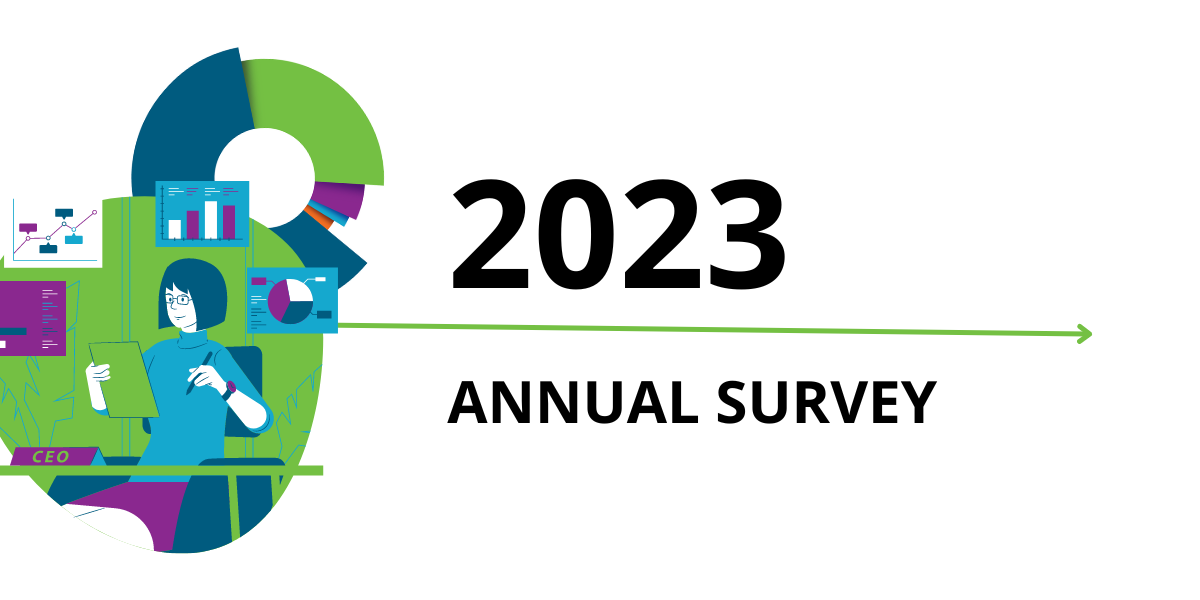
Our 2023 annual community survey results reveal the impact Beyond Benign’s programming has had on empowering educators to advance green chemistry in classrooms and labs across the globe.
In our pursuit of a more sustainable world, Beyond Benign has been championing the advancement of green chemistry in education for more than 15 years. Our annual survey, conducted within our education community, shows that this cohort continues to become more deeply engaged and passionate about green chemistry due to participating in the community over the last year.
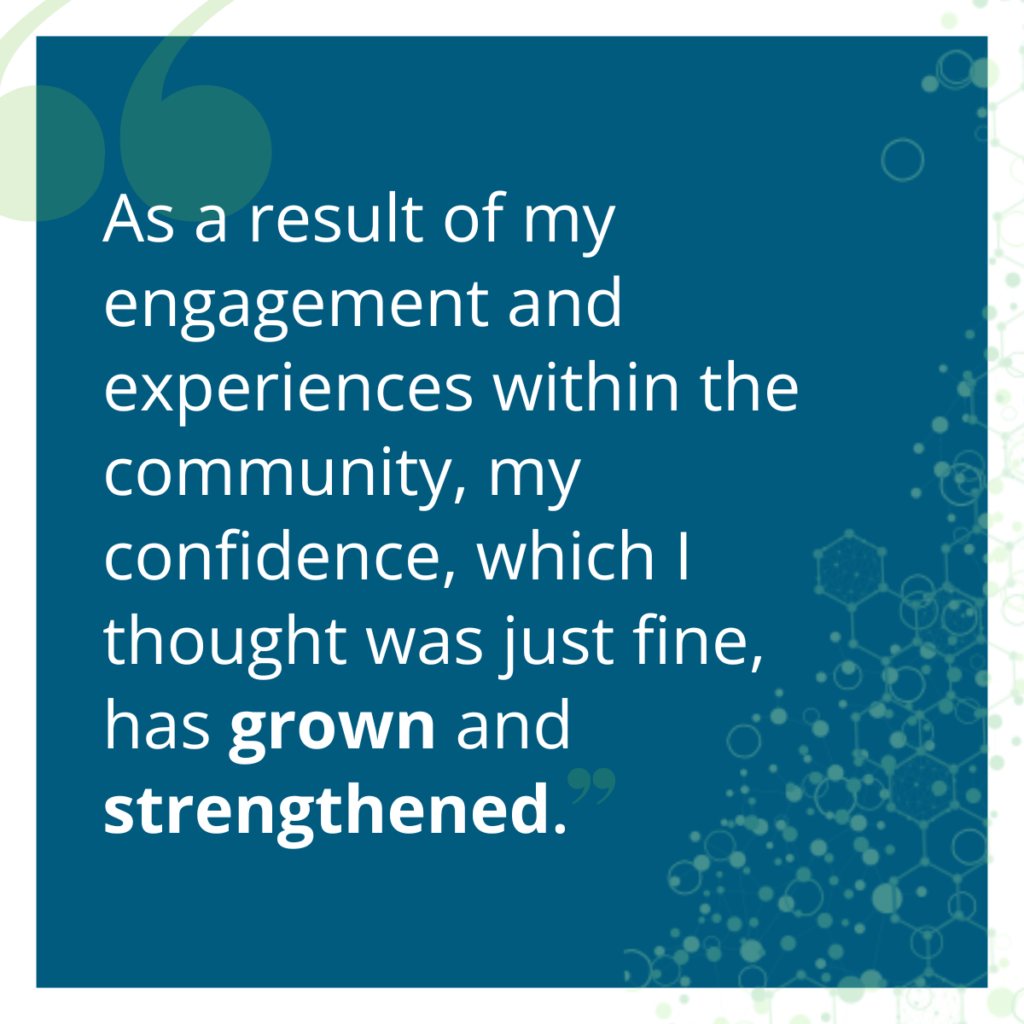 The survey results reveal a remarkable increase in the community’s understanding of green chemistry, reflecting their dedication to progress and innovation. This knowledge empowers them to lead with sustainability at the core of their professional endeavors. Equally encouraging is the growing belief among educators that green chemistry is essential for their students. By instilling environmental consciousness in the minds of young chemists, Beyond Benign’s education community is sowing the seeds for a future generation of sustainability leaders.
Beyond Benign’s programming has not only forged strong connections within the community but also ignited transformation in students. By intertwining chemistry with real-world implications, our educators believe their students are engaging more passionately and gaining a deeper understanding of their discipline’s impact on the world.
We celebrate this collective journey of growth and impact, looking forward to even more years of progress, innovation, and positive change in the field of green chemistry education.
Keep reading to delve deeper into the results of our annual community survey.
The Respondents
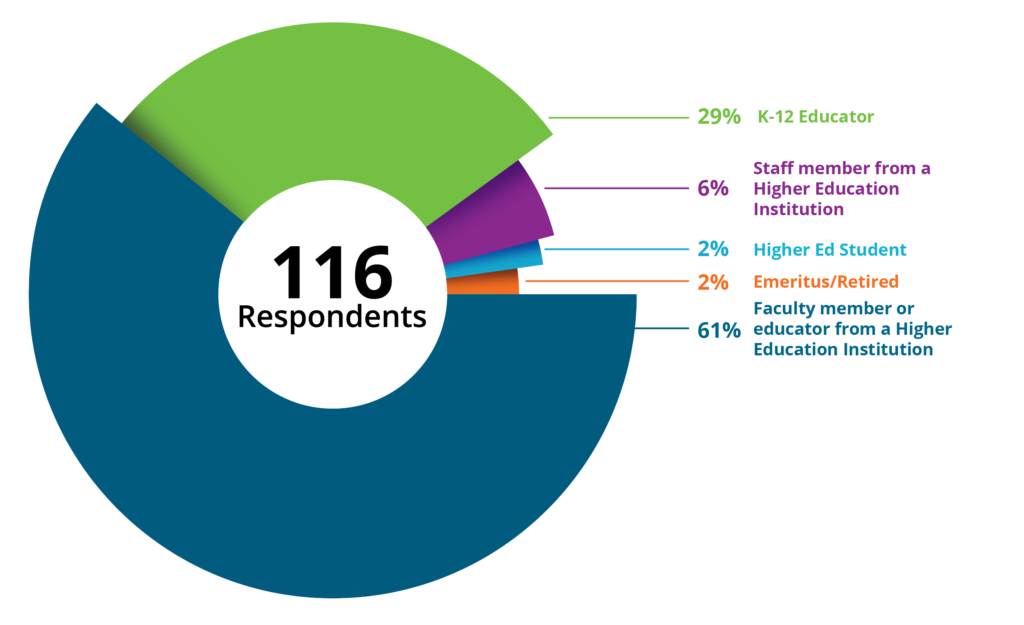
We were thrilled to hear from 116 members of our education community. These respondents were mostly faculty and K-12 educators, with some industry practitioners, education administrators and students included.
Personal Growth for Educators
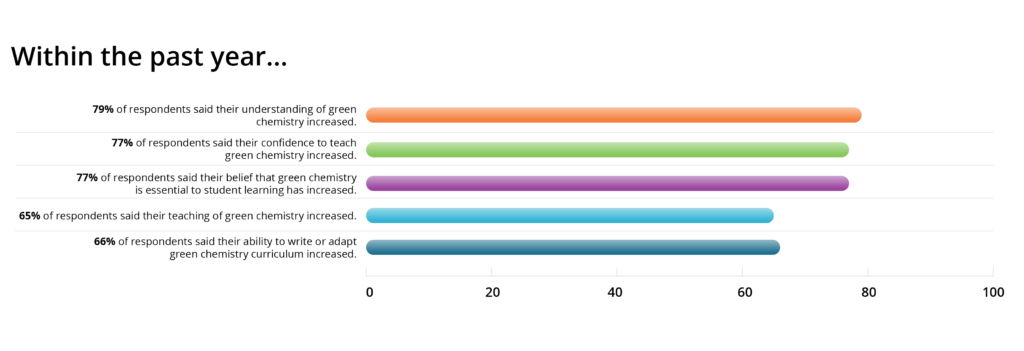
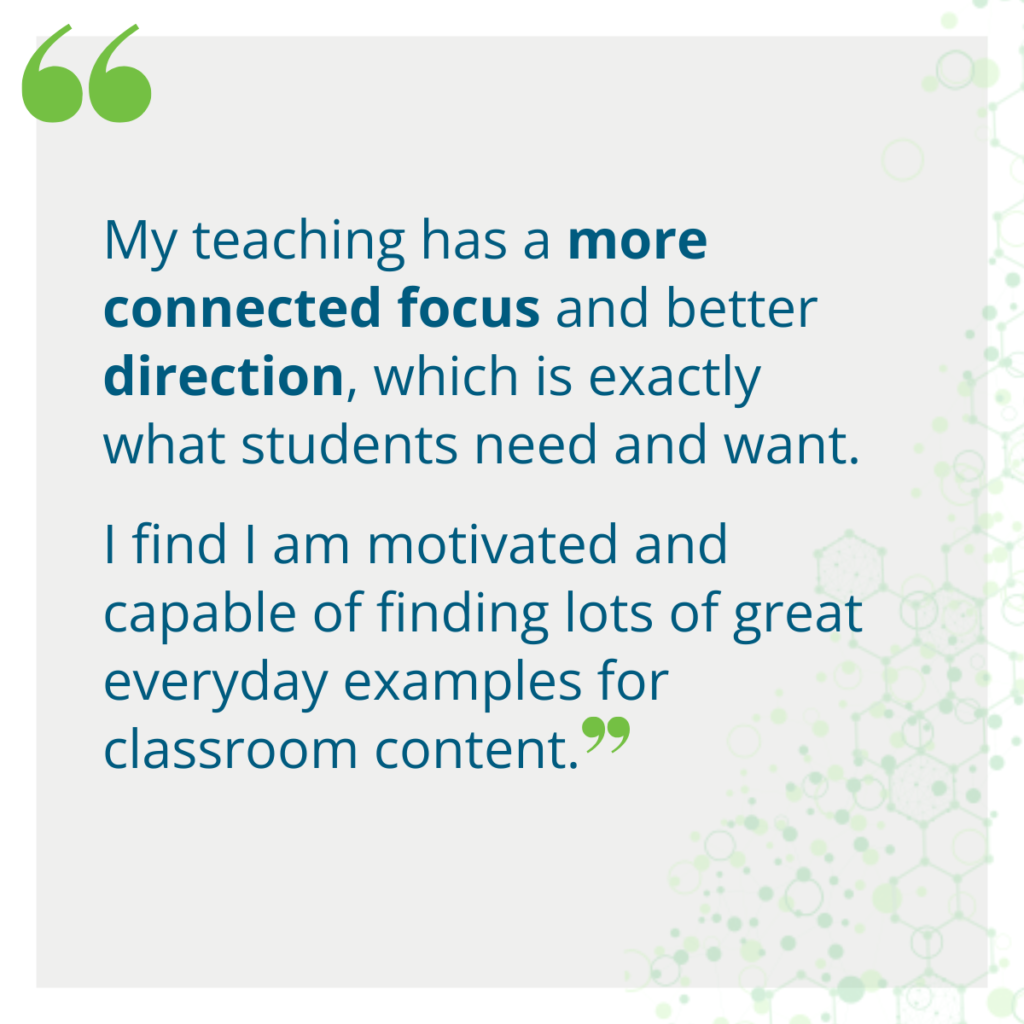 Within the past year, educators who have participated in Beyond Benign’s programming experienced remarkable personal growth, as evidenced by the survey results. Many respondents have deepened their understanding of green chemistry, fueling their commitment to sustainability, and translating into increased confidence to teach green chemistry effectively in classrooms and labs.
A high percentage of educators also recognize the indispensable role of green chemistry in student learning, reaffirming its significance in shaping environmentally-conscious minds. This shared belief spurred 65% of respondents to incorporate green chemistry principles more actively in their teaching, cultivating a greener educational experience for their students. Additionally, 66% of educators have honed their skills in creating or adapting green chemistry-focused curriculum, ensuring that future generations are equipped with relevant and impactful knowledge for a sustainable world.
Educator Leadership & Peer Mentorship
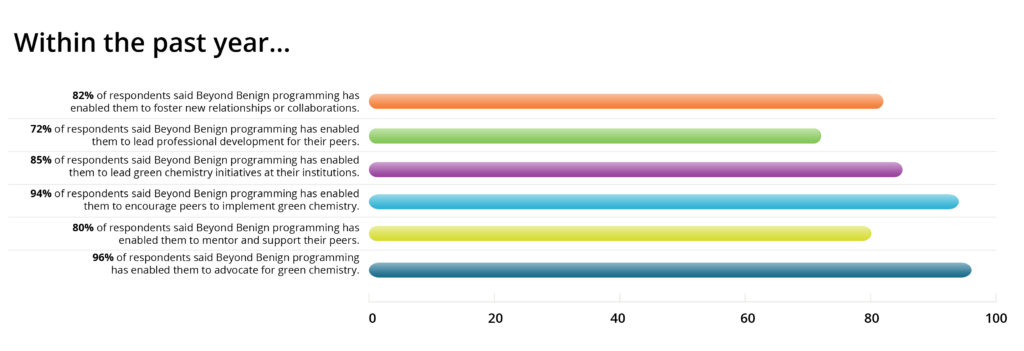
 Over the past year, educators in the Beyond Benign community have experienced significant growth in their green chemistry leadership and connections with peers. The survey revealed that an overwhelming percentage of respondents credited Beyond Benign for fostering new relationships and collaborations within the green chemistry community. Many of these educators reported that the organization’s programming empowered them to lead professional development initiatives for their peers, enhancing knowledge dissemination within their institutions.
Survey respondents are stepping into leadership roles to drive green chemistry initiatives within their educational establishments, and they’re motivated to actively encourage their peers to implement green chemistry practices, creating a powerful ripple effect of sustainability advocacy. A resounding 96% of educators recognized the impact of Beyond Benign’s advocacy efforts, empowering them to become ardent advocates for green chemistry and its significance in shaping a sustainable future.
Bringing Green Chemistry into the Classroom & Achieving Student Outcomes
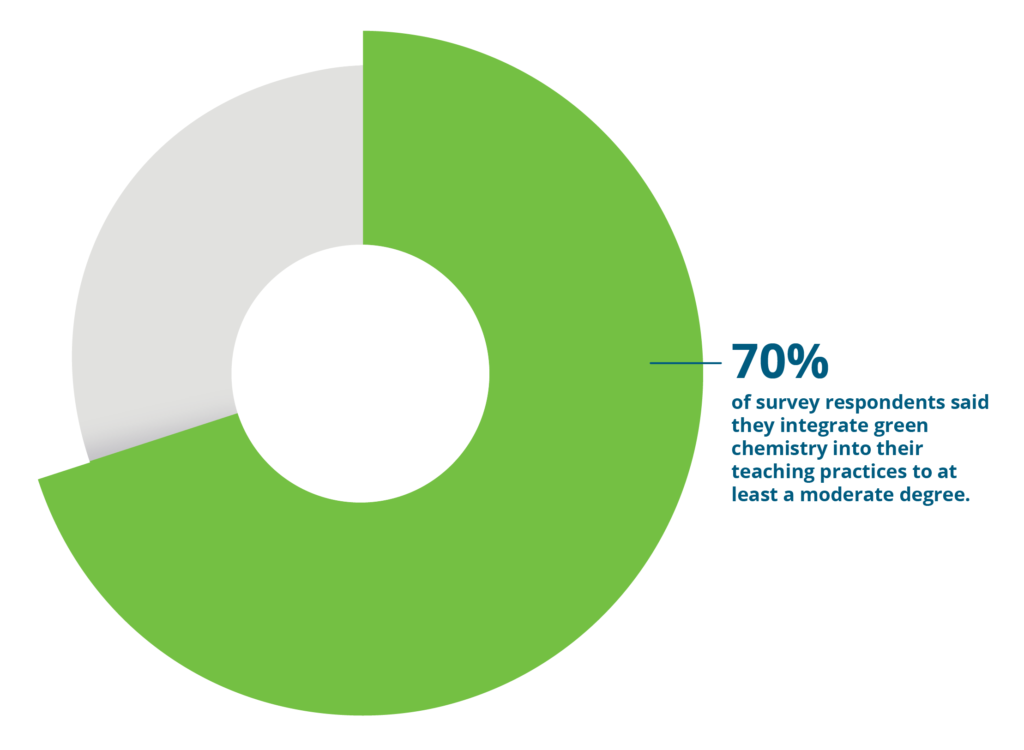
Survey respondents have demonstrated a strong commitment to integrating green chemistry into their teaching practices, with the majority actively incorporating it in their classrooms and labs.
The impact of this approach on students’ learning experiences has been remarkable, as observed over the past year. An overwhelming majority of educators reported an increase in their students’ interest, confidence, and understanding of chemistry in relation to sustainability and the world around them. Students’ interest in pursuing STEM careers and their preparedness to bring green chemistry skills into the workforce have also seen significant growth. These survey findings underscore the powerful influence of green chemistry education in shaping a generation of environmentally-conscious and motivated learners.
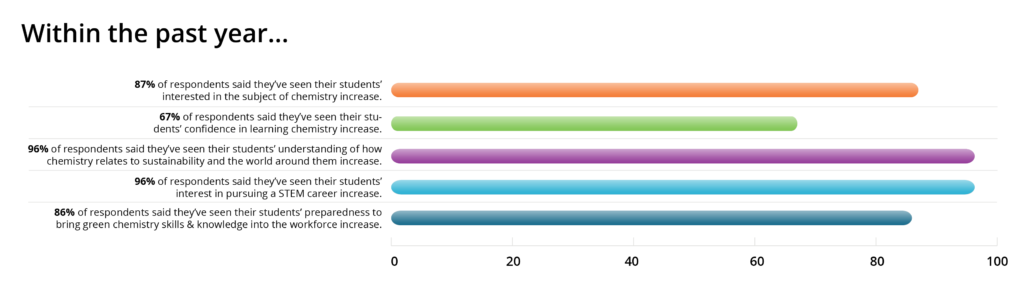
We continue to be inspired by our community of educators and its growing engagement and passion for green chemistry. The results of our annual survey showcase a remarkable increase in educators’ understanding of green chemistry, empowering them to lead with sustainability as a core focus in their teaching. Educators are recognizing the essential role green chemistry plays in students’ learning. As a result, students are exhibiting heightened interest, confidence, and understanding of the interplay between chemistry and sustainability. These survey results underscore the transformative impact of green chemistry education, shaping a new generation of students who are deeply committed to environmental awareness and driven to make a positive impact in the world.
The Transformative Influence of Green Chemistry Educators
October 5, 2023
Our 2023 annual community survey results reveal the impact Beyond Benign’s programming has had on empowering educators to advance green chemistry in classrooms and labs across the globe. In our […]
Categories:
CST Sponsors Beyond Benign to Expand Global Access to Green Chemistry Education
Danvers, MA, USA – August 29, 2023 – Cell Signaling Technology (CST), a life science discovery technology company and leading provider of antibodies, kits, and services, today announced a partnership with global green chemistry education nonprofit Beyond Benign. As part of CST’s ongoing commitment to supporting Science, Technology, Engineering, and Mathematics (STEM) initiatives and promoting sustainability in life sciences, the partnership will help prepare the next generation of scientists with the skills and expertise needed to apply green practices in the lab.
“Like Beyond Benign, CST is passionate about reducing the environmental impact the life sciences industry has on ecosystems worldwide, and we recognize that the next generation of scientists will play a critical role in bringing about a sustainable future,” said Anthony Michetti, Director of Sustainability at CST. “Investing in students and education is one of the many ways CST is working to inspire industry-wide change for a healthier, more diverse global community.”
Working together, CST and Beyond Benign will provide educators with free, open access to green chemistry teaching resources and the support needed to enable sustainable science education in the classroom. As part of the partnership, CST has become a founding sponsor of Beyond Benign’s Green Chemistry Teaching and Learning Community (GCTLC), which will launch in Fall 2023. The GCTLC is an online platform that will provide global access to resources and training for more than 4,000 faculty members worldwide. By helping educators develop the skills needed to more effectively train the next generation of scientists to think more sustainably, and ultimately carry this knowledge on into their careers, the GCTLC advances Beyond Benign’s goal of ensuring 25% of graduating chemists have a background in green chemistry by 2025.
“Beyond Benign is fostering a global community of transformation that will help solve the world’s most pressing sustainability challenges,” said Dr Amy Cannon, Co-founder and Executive Director of Beyond Benign. “Support from CST will help us to effect systemic and lasting change in chemistry education that will help to empower future generations to make more sustainable choices to reduce or eliminate hazardous substances and improve human health and the environment.”
Support of Beyond Benign is part of CST’s commitment to 1% for the Planet, through which the company has promised to donate at least 1% of its total annual revenue to a network of nonprofit organizations tackling the world’s most pressing environmental issues.
Higher Ed Chemistry departments interested in learning more about Beyond Benign’s Green Chemistry Commitment (GCC) program can do so by visiting Beyond Benign’s GCC webpage, or by contacting Dr Natalie O’Neil, Beyond Benign’s Director of Higher Education, at Natalie_ONeil@beyondbenign.org.
Community members interested in learning more about the GCTLC platform can visit Beyond Benign’s website, or alternatively can reach out to Dr Jonathon Moir, Beyond Benign’s Senior Program Manager for the GCTLC, for more details.
About Cell Signaling Technology
Cell Signaling Technology (CST) is a different kind of life science company—one founded, owned, and run by active research scientists, with the highest standards of product and service quality, technological innovation, and scientific rigor. Founded in 1999 and headquartered in Danvers, Massachusetts, USA, CST employs over 600 people worldwide. We consistently provide fellow scientists around the globe with best-in-class products and services to fuel their quests for discovery. CST is a company of caring people driven by a devotion to facilitating good science—a company committed to doing the right thing for our Customers, our communities, and our planet. cellsignal.com
Follow Cell Signaling Technology on Twitter @CellSignal, on Facebook @cellsignal, and on LinkedIn.
About Beyond Benign
Beyond Benign, a 501(c)3 nonprofit, envisions a world where the chemical building blocks of products used every day are healthy and safe for humans and the environment. Beyond Benign’s mission is to foster a green chemistry community that empowers educators to transform chemistry education for a sustainable future. Beyond Benign is working to equip educators from K-20 with the ability to teach chemistry and STEM through a lens of sustainability grounded in the 12 principles of green chemistry. By providing educators with tools, training, and a peer support network, educators are equipped to train the next generation of scientists and citizens with the skills and knowledge to create and choose products that are safe for human health and the environment.
Co-founded in 2007 by Dr John Warner, the co-founder of the field of green chemistry, and Dr Amy Cannon, who holds the world’s first PhD in Green Chemistry, Beyond Benign has an extensive history of service. Over the past 15 years, Beyond Benign has trained over 6,500 K-12 teachers in sustainable science and green chemistry, designed over 200 open-access lessons, reached over 35,000 youth and community members through outreach, & partnered with over 130 universities to transform chemistry education. Together we can catalyze the development of green technological innovations that result in safer products and processes in support of a sustainable, healthy society.
Sign-up for Beyond Benign’s newsletter, follow on Twitter @BeyondBenign, on Facebook @BeyondBenign, and on LinkedIn.
CST Sponsors Beyond Benign to Expand Global Access to Green Chemistry Education
August 29, 2023
Danvers, MA, USA – August 29, 2023 – Cell Signaling Technology (CST), a life science discovery technology company and leading provider of antibodies, kits, and services, today announced a partnership […]
Categories:
- « Previous Page
- 1
- …
- 6
- 7
- 8
- 9
- 10
- …
- 19
- Next Page »


