





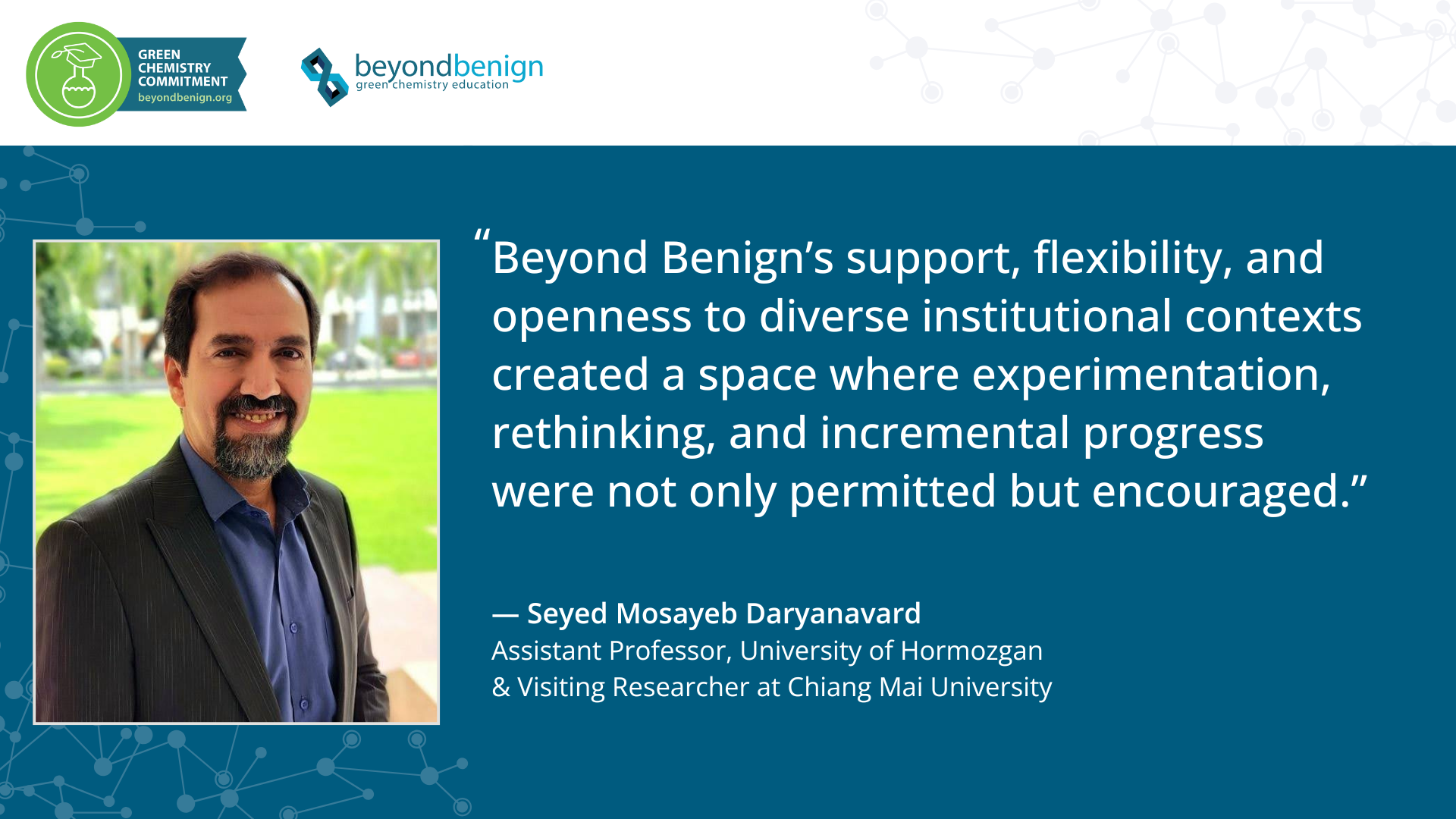
 We are inspired by this reflection from community member Seyed Mosayeb Daryanavard, Assistant Professor of Analytical Chemistry at the University of Hormozgan (Iran) and a visiting researcher at Chiang Mai University (Thailand). In 2024, Seyed helped bring the Green Chemistry Commitment (GCC) to the University of Hormozgan, supporting the Department of Chemistry in integrating green chemistry principles and practices into its curriculum. Read more about Seyed’s green chemistry journey below!
Contributed by Seyed Mosayeb Daryanavard
My engagement with green chemistry did not begin with a formal project or an organizational requirement. It began much earlier, during my graduate studies, a path deeply influenced by the specific environmental conditions of southern Iran. Living on an Island (Qeshm) and coastal area like Bandar Abbas, where marine pollution, industrial activities, water scarcity, and ecosystem fragility are part of everyday reality, meant that chemistry never remained a purely theoretical science for me. Gradually, this simple but persistent question emerged: What kind of chemistry do we study, teach, and apply, and what impact does this chemistry have on the environment and society?
In the early years of my academic career in the chemistry department at the University of Hormozgan, green chemistry was not yet a structured part of the curriculum. However, I became increasingly interested in concepts such as waste prevention, the use of safer solvents, and environmentally friendly analytical methods. This interest gradually shaped not only my research path, but also my overall view of chemistry education. Over time, green chemistry became more than a research topic for me; it became a framework through which I evaluated laboratory practices, educational priorities, and the social responsibility of universities.
My collaboration with Beyond Benign was an important turning point in transforming these individual concerns into a collective and institutional effort. For the University of Hormozgan, joining Beyond Benign’s Green Chemistry Commitment (GCC) was not merely a symbolic act; it provided us with a common framework, a common language, and a sense of belonging to a global community that truly believes in the transformative power of green chemistry education. As the coordinator, I have seen firsthand how Beyond Benign functions not as an external observer but as a supportive partner for local change.
One of the most valuable aspects of working with Beyond Benign was that it encouraged us to think systematically, not as a piecemeal effort. Rather than seeing green chemistry as simply an “add-on” to existing courses or projects, we were encouraged to rethink the foundations of chemistry education and research. This perspective has led to deeper conversations within the chemistry department, among faculty and students, about the long-term implications of our choices in teaching, thesis guidance, and research design.
Over the past few years, this collaboration has led to tangible and meaningful changes in the chemistry department at the University of Hormozgan. Graduate research has become a particularly effective platform for implementing the 12 Principles of Green Chemistry. Between 2020 and 2025, more than 30 master’s theses directly incorporated one or more green chemistry principles, including the use of renewable resources, plant-based nanomaterials, heterogeneous catalysis, safer solvents, and environmental pollution monitoring related to regional challenges. Importantly, these projects were not imposed in a prescriptive manner, but rather emerged from conversations with students. Many students gradually came to see green chemistry not as a limitation but as a scientifically rich and socially meaningful approach. At the faculty level, the Beyond Benign framework also helped foster interdisciplinary collaboration. Researchers working in environmental monitoring, catalysis, nanomaterials, sustainable solvents, analytical chemistry, and chemistry education increasingly saw their work as interconnected components of a shared vision of sustainability.
For me, this period coincided with a deeper focus on green analytical chemistry, particularly in the development and application of green assessment tools such as AGREEprep. A central question gradually shaped my research path; one that still guides my work: How can the “greenness” of analytical methods be assessed quantitatively, transparently, and scientifically, without sacrificing analytical performance?
Education was another area where the impact of Beyond Benign was clearly visible. Courses such as Green Chemistry and the Environment, Green Analytical Chemistry, and Green Organic Synthesis were gradually revised to create a stronger link between theoretical principles and practical laboratory experience. Redesigning experiments to replace hazardous solvents with water, ionic liquids, or deep eutectic solvents was not always easy, especially given resource constraints. However, the educational value of these changes, both in terms of student safety and shaping their attitudes, was abundantly clear. The Beyond Benign philosophy assured us that even small, incremental changes can have lasting effects.
My journey in green chemistry did not end at the University of Hormozgan. Motivated to further develop my expertise in green analytical chemistry and sustainability assessment, I took the next step by joining Chiang Mai University, northern Thailand. This move allowed me to experience new research horizons, interact with new academic environments, and expand my work on green indicators, sustainability metrics, and comprehensive assessment frameworks. Encountering new colleagues, students, and academic cultures reaffirmed my belief that green chemistry thrives above all through dialogue and cross-border engagement.
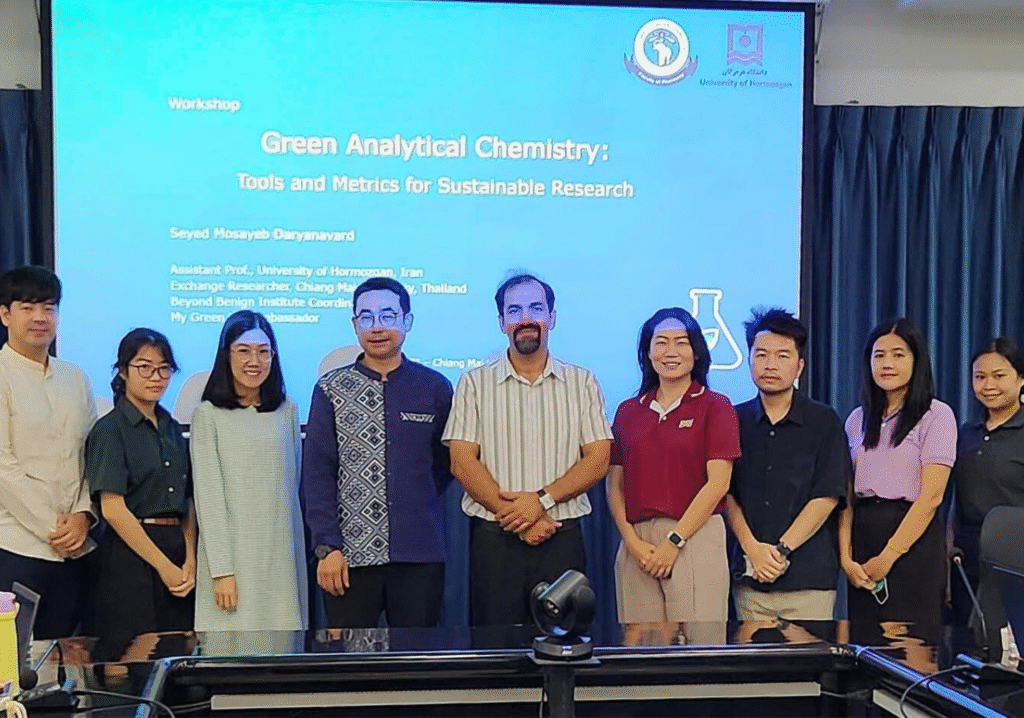
Seyed Mosayeb Daryanavard (center) and Prof. Chalermpong Saenjum’s research group at a Green Analytical Chemistry Workshop at Chiang Mai University.
Continuing this path led to another milestone: being honored with an invitation from Prof. Muftah El-Nass to serve as a keynote speaker at the Qatar University Green Chemistry Symposium in December 2025. For me, this invitation was not only an academic honor but also a personal confirmation of the coherence and meaning of this path, from local activities at the University of Hormozgan to participation in international dialogues. This experience demonstrated that a sustained commitment to green chemistry and analytical chemistry, along with the support of our institutions, Beyond Benign can pave the way for new conversations and collaborations.
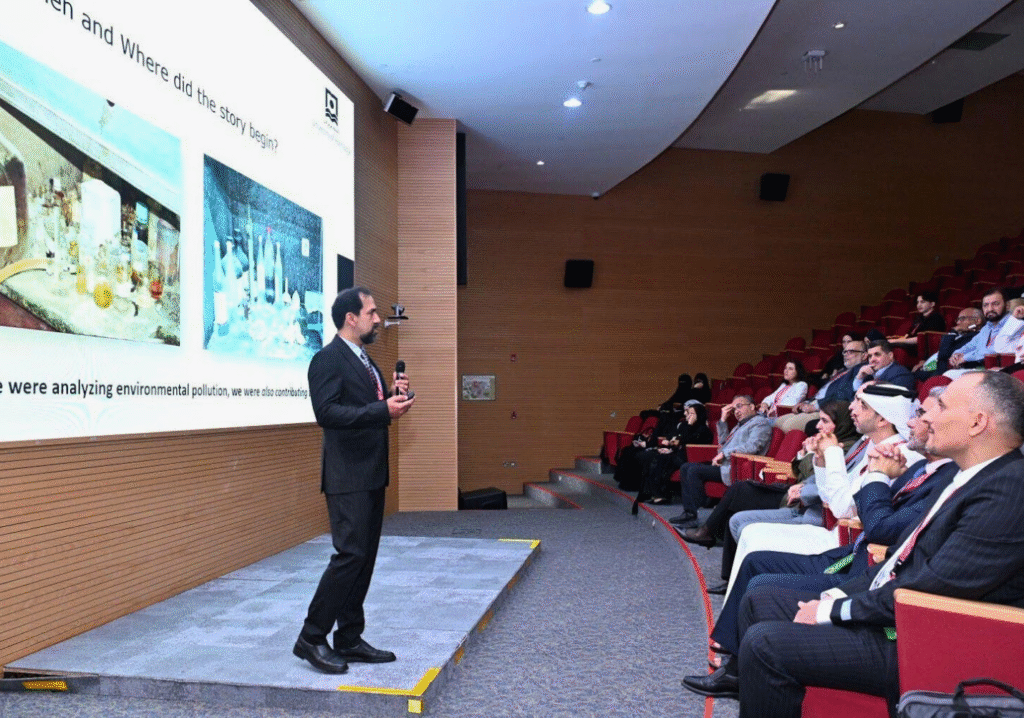
Seyed Mosayeb Daryanavard speaking at the Green Chemistry Symposium at Qatar University.
On a more personal level, working with Beyond Benign has also changed the way I view the role of a faculty member. Today, I see myself not simply as a researcher or lecturer, but as a mediator between the global principles of sustainability and the local realities of higher education. Beyond Benign’s support, flexibility, and openness to diverse institutional contexts created a space where experimentation, rethinking, and incremental progress were not only permitted but encouraged.
When I look back over the years, I see progress not just in the number of courses, theses, or reports, but in changing attitudes. Green chemistry at the University of Hormozgan is no longer an abstract or imported concept, but has become a practical, indigenous approach shaped by the environmental needs of the region and the scientific capacities of the university. This experience also explains why I continue to focus on developing green assessment matrices today: Without transparent and reliable tools to measure progress, even the sincerest green efforts may go unnoticed.
My motivation to continue on this path and to continue working with Beyond Benign stems from a shared understanding: that green chemistry is not a final, fixed paradigm, but a dynamic, evolving process. It is kept alive by continuous learning, engaging with new people, and forming new partnerships. I am eager to continue on this path, take on new challenges, and seek to build partnerships that contribute to a more responsible, reflective, and sustainable future for chemistry.
— Seyed Mosayeb Daryanavard
Assistant Prof., University of Hormozgan, Iran
Visiting Researcher, Chiang Mai University, Thailand
s.m.daryanavard@gmail.com
How to get involved:
- Connect with Seyed Mosayeb Daryanavard on the Green Chemistry Teaching and Learning Community (GCTLC), a free online platform for connecting with the global community.
- Not yet part of the Green Chemistry Commitment (GCC)? Learn how your institution can become a signer and provide students with essential skills and training for today’s workforce.
- Subscribe to Beyond Benign’s newsletter for the latest updates from the green chemistry community.


